Your dog suddenly lifts an ear. You stop talking and listen. Nothing. A moment later, a sound reaches you too. For a second, it feels as though your dog knew a secret.
That small moment is the doorway into The Sheepdog Who Could Hear the Fairies. Pip’s adventure is fiction, but its hawthorn tree and mysterious sounds have connections with Irish folklore. Here is a closer look at those traditions, with ideas for exploring them as a family after listening to the story or colouring its pages.
Why the hawthorn belongs in this story
A lone hawthorn can look unremarkable until someone tells you its story. The National Museum of Ireland records traditions linking hawthorn with the fairies, including warnings against damaging a tree standing alone in the open. These are recorded beliefs, not evidence of supernatural powers. [1]
The museum also describes May Bush customs in which a bush, often hawthorn, was decorated with ribbons and other bright materials. Customs differed between places. There was never one rulebook followed by every Irish family. [1]
In Pip’s adventure, blossom appearing in September signals that something unusual is happening. Hawthorn normally flowers in late spring, often around May. Its familiar autumn feature is the red fruit known as a haw. The story deliberately plays with that seasonal contrast. [2]
Music from somewhere you cannot see
An account called The Fairy Tune, preserved in the Schools’ Collection on Dúchas, describes a piper walking with his dog and hearing music from a “lios”, or ringfort, while standing beneath a hawthorn. It was recorded at Shanballard in County Galway. [3]
That is a useful example of these motifs appearing together in an older recorded tale. It does not establish that fairy music was real. Pip’s silver bell, its four notes and its call to the animals belong to this modern fictional adventure.
The children who helped preserve the stories
There is a lovely connection between Granny Nóra’s young listeners and the people who preserved much of Ireland’s folklore. Between 1937 and 1939, children at thousands of schools in the then Irish Free State collected local material from parents, grandparents and neighbours. Their work became the Schools’ Collection. [4]
They recorded more than fairy stories. The collection includes games, memories, local place names and accounts of working life. Ordinary conversations became a record that other families can explore today. [4]
Try a small version at home. Ask an older relative which story they remember hearing as a child. Write down who told it, where they lived and any details they are unsure about. Keep “I remember” separate from “someone told me”. Both are interesting, but they tell us different things.
The people behind the fairy fort
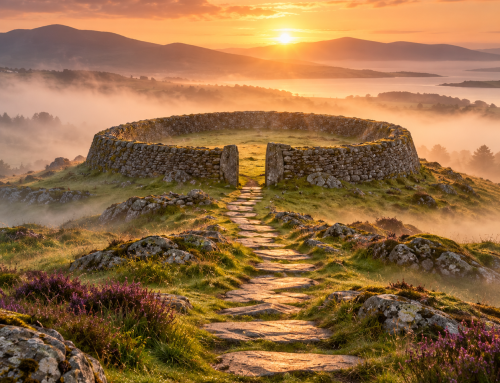
Pip’s grassy hill is an invented setting, not an identified archaeological site. Real Irish ringforts, however, can take us closer to the lives of past households. Many were enclosed farmsteads during the early medieval period, roughly AD 500–1100, with houses and other buildings inside an earthwork or stone boundary. [5]
An enclosure that later gathered strange stories might once have been a place of cooking, repairs and daily work. Thinking about those households gives children another question to ask: who lived here before anyone called it a fairy fort? Folklore and archaeology offer different kinds of evidence about the same landscape.
What a listening dog can really tell us
Dogs are particularly sensitive to some higher-frequency sounds, and their hearing differs from ours. A dog reacting when we hear nothing need not be reacting to anything mysterious. Research also reminds us that ordinary household sounds can distress some dogs. [6]
Pip’s ability to hear the fairy bell is make-believe. Let a real dog enjoy a quiet walk without testing its ears with whistles, recordings or sudden noises. Watching an ear turn towards a rustle is interesting enough.
The wildlife beyond the magic
The hawthorn is worth noticing even without a fairy story. Its flowers offer nectar and pollen to insects; its fruits feed birds; and its dense, thorny growth can provide nesting shelter. Leaves with deep lobes, sharp twigs and autumn haws are useful clues to its identity. [2]
The story’s bell does not explain real animal behaviour. It gives young readers a reason to care about creatures they might otherwise overlook. You do not need to find every animal from Pip’s adventure. A bird calling from a hedge, an insect on a leaf or a breeze moving the branches is plenty to begin with.
Try a one-minute listening adventure
Choose a safe place with a grown-up: a garden, a park bench or an open window will do. Stay still for one minute. Keep your eyes open if that feels more comfortable, and count the different sounds you notice. Which is nearest? Which seems farthest away? Which remains a mystery?
Afterwards, draw a sound map. Put yourself in the middle and add marks for the sounds around you. A wavy line might mean leaves rustling; a dot might mean a distant tap. Someone who does not hear those sounds can make a movement map instead, watching leaves, shadows and birds.
Stay on permitted paths, keep dogs under control and leave wildlife undisturbed. Enjoy hawthorn without picking its flowers or tasting unfamiliar berries. There is no need to go out after dark or follow an animal to its shelter.
Bring the adventure to the colouring table
The Sheepdog Who Could Hear the Fairies is also a story colouring book for ages 6–9, with 20 illustrated scenes and short captions. It follows Pip, Granny Nóra, Aoife, Finn and Orla through a mystery about listening and kindness.
Read a caption together, then let the child choose the colours. Ask what Pip might be thinking, or why giving something back can be difficult. The pages do not need to match anyone else’s version. The conversation matters more than staying inside every line.
Listen to The Sheepdog Who Could Hear the Fairies on YouTube and explore its companion colouring book in Pip’s Irish Story Adventures (available on Amazon). Then return to Cosy in Ireland for more stories about Ireland’s folklore, history and wildlife. What small sound would you put on your family’s map?
Sources and further reading
[1] National Museum of Ireland. Hawthorn information sheet.
https://www.museum.ie/getmedia/6044d82b-1b27-4475-ae45-aec38747c0eb/Hawthorn-Information-Sheet.pdf
[2] Woodland Trust. Hawthorn identification and wildlife value.
https://www.woodlandtrust.org.uk/trees-woods-and-wildlife/british-trees/a-z-of-british-trees/hawthorn/
[3] National Folklore Collection UCD via Dúchas. The Fairy Tune, Schools’ Collection, volume 0083, page 325, Shanballard, County Galway.
https://www.duchas.ie/en/cbes/4602712/4597824/4632825
[4] Dúchas. The NFC Collections and the Schools’ Collection.
https://www.duchas.ie/en/info/cbe-collections
[5] Ask About Ireland. Ringforts and Ráthanna.
https://www.askaboutireland.ie/reading-room/history-heritage/monuments-built-heritage/our-legacy-of-ancient-mon/ringforts/
[6] Grigg and colleagues, Frontiers in Veterinary Science, 2021. Stress-Related Behaviors in Companion Dogs Exposed to Common Household Noises, and Owners’ Interpretations of Their Dogs’ Behaviors.
https://pmc.ncbi.nlm.nih.gov/articles/PMC8606548/
Sources checked 8 October 2026. Archive tales are used as evidence of recorded folklore, not as proof that their supernatural events occurred.