
Would you stop work because turning a wheel might bring disaster?
Ireland’s eerie St Martin’s Day superstition
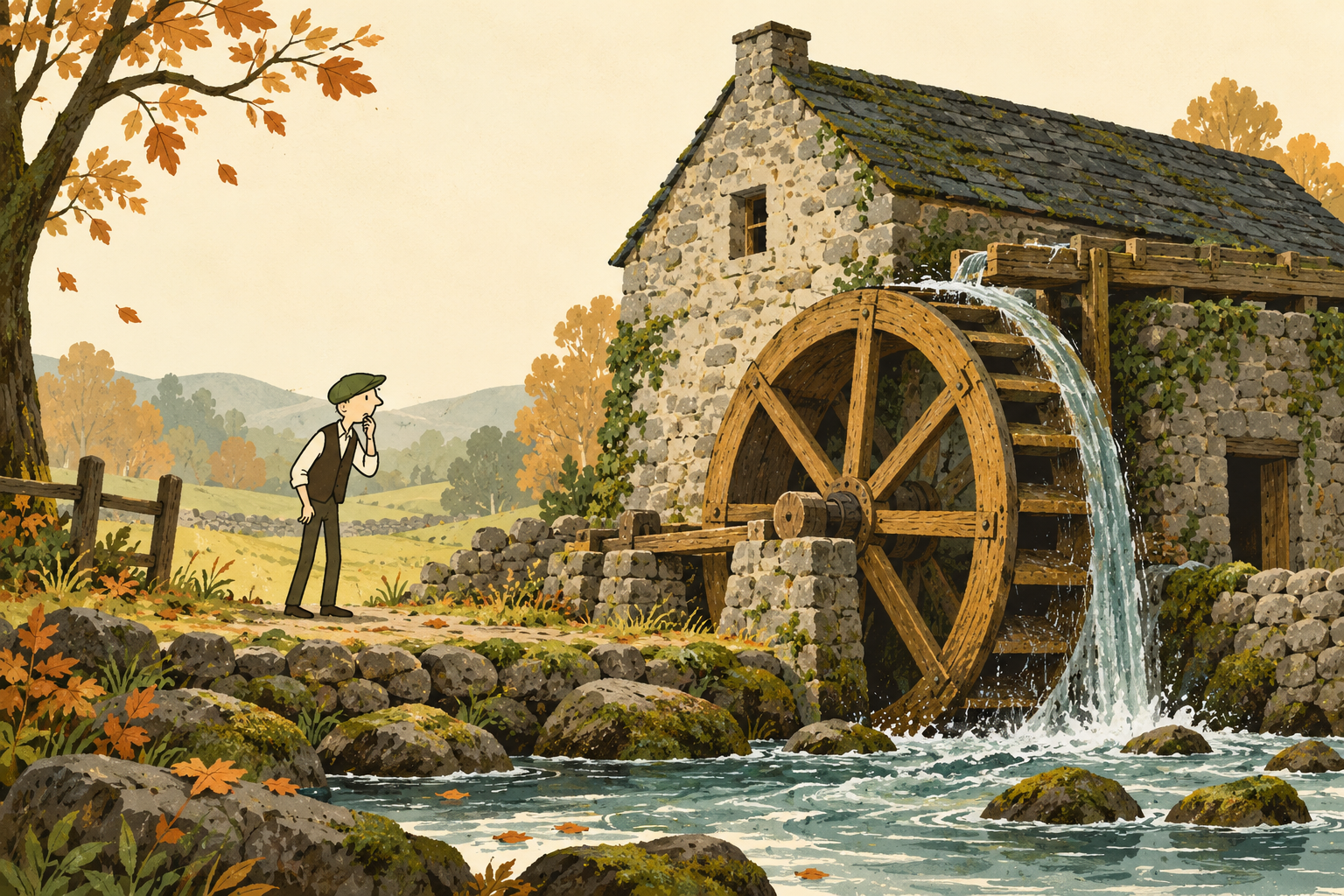
Would you leave a job unfinished because you were afraid to turn a wheel? It sounds like an unlikely question until you meet the mill owner at the centre of a Kerry folk tale. He had customers waiting, work to do and a very particular reason for wanting his machinery to stay silent.
A November day when work could wait
St Martin’s Day falls on 11 November and is also known as Martinmas. In parts of Ireland, customs associated with the saint included avoiding work that turned a wheel. Milling and spinning could stop; wheeled journeys could also be considered unlucky. This was a local tradition with variations, rather than a rule followed by everyone across Ireland. [1]
One explanation linked the prohibition to a story that Saint Martin had died between wheels. That explanation belongs to the folklore surrounding the day; it should not be repeated as an established fact about the saint’s death. [1]
The customers who would not wait
The Schools’ Collection preserves an account from Ballyduff in County Kerry, attributed to James Houlihan of Benmore. It places a mill at Ballinoe, between Causeway and Ballyheigue. [2]
In the tale, the owner, named as Mr Cunihan, wants to leave the mill idle on St Martin’s Day. People arrive with grain and insist on having it milled because they have travelled a considerable distance. He gives way. Machinery breaks, repairs follow, and the mill starts again. Then comes the supernatural warning: the water becomes blood, and the wheel will not move. [2]
Our short animation compresses that sequence. (Available on YouTube in November). The fuller account makes the owner’s decision more interesting: he is reluctant, facing pressure from people who do not want their journey wasted. It is a recognisable predicament, even if the consequence belongs to legend.
More than a silent wheel
Martinmas customs also reached into the home. On 10 November, St Martin’s Eve, or on the feast day itself, some households slaughtered a bird or animal and used its blood in protective rituals. Doorways and the corners of houses could be marked in the belief that this would prevent misfortune. The meat was subsequently eaten. These practices were recorded unevenly across Ireland and were less common in Ulster and along the east coast. [1]
What can we actually believe?
An archive can establish that a story was collected. It cannot, simply by preserving that story, establish that its supernatural events occurred. The Kerry account is evidence of a tradition being told, not proof that water changed into blood. [2]
My reading of the tale is that its force comes from an ordinary choice: honour a shared custom, or get the work finished. You do not have to believe in the punishment to recognise the tension. Someone always has a reason why the rule should not apply today.
Watch The Forbidden Wheel from Ireland: Fact or Folklore alongside this companion piece. Then consider the question the story leaves behind: if you had been standing beside that mill, would you have asked the owner to start it? Explore more Irish history and folklore here at Cosy in Ireland.
Sources
[1] Marion McGarry, “Why November 11th was a day for blood sacrifice rites in Ireland”, RTÉ Brainstorm, updated 11 November 2025.
https://www.rte.ie/brainstorm/2025/1111/1089533-martinmas-blood-sacrifice-rites-ireland-november-11th/
[2] National Folklore Collection, UCD, The Schools’ Collection, volume 0415, page 173, “Another Story about St Martin’s Day”, Ballyduff B. N. School, County Kerry. Informant: James Houlihan, Benmore. Available through Dúchas.
https://www.duchas.ie/en/cbes/4666609/4666442/4682433
