Companion to the Ireland: Fact or Folklore episode: Giant’s Causeway: Giant or Volcano?
A stone pavement runs towards the sea, its columns fitted together so neatly that it is easy to imagine someone laying them by hand. Then you look at the cliffs behind it and the scale becomes harder to explain. Who could possibly have built all this?
At the Giant’s Causeway in County Antrim, the answer depends on the question. Geology explains how the rocks formed. Folklore tells us how people gave this extraordinary coast a story. This companion explores both, alongside the working lives and wildlife that deserve a place in the picture.
The giant who needed a clever plan
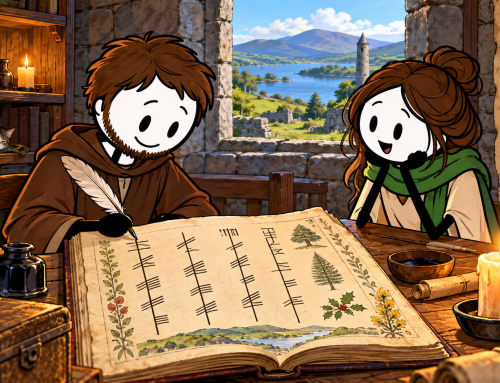
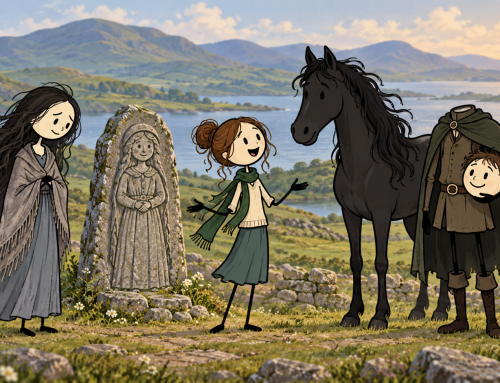
In one familiar version of the legend, Finn McCool builds a crossing to confront the Scottish giant Benandonner. When he sees how enormous his rival is, Finn retreats home. His wife Oonagh has a solution: disguise him as a baby and put him in a cradle.
Benandonner arrives and sees the enormous infant. If the baby is that size, what must its father look like? He flees towards Scotland, tearing up the crossing behind him. [1]
Oonagh is the character worth remembering here. In this telling, the crisis is solved by her quick thinking. The biggest person in the room is not necessarily the one who controls the outcome.
There is no single fixed Causeway legend. The National Trust also records a love story in which Finn builds a crossing to reach a Scottish maiden, while his grandmother repeatedly destroys his work with storms. These are versions of folklore, rather than eyewitness accounts or evidence that a bridge once joined the shores. [2]
What really formed the stones
The Causeway contains approximately 40,000 basalt columns. UNESCO recognises the wider Giant’s Causeway and Causeway Coast as a World Heritage Site, inscribed in 1986 for its natural beauty and geological importance. Its rocks record volcanic activity around 60 million years ago. [3]
As the North Atlantic began to open, lava erupted through weaknesses in the Earth’s crust. The British Geological Survey describes repeated eruptions, followed by a long pause when weathering and erosion changed the landscape. Later lava entered valleys; at the Causeway it accumulated in a thick body described as a lava lake. [4]
As this lava solidified and cooled, it contracted. Cracks developed through the rock, dividing it into columns. The repeated shapes are the result of physical processes, not masonry. Think of a surface cracking as it shrinks, then imagine those cracks extending through a substantial thickness of rock. [4]
The popular description “hexagonal stones” is a useful starting point, but the shapes vary: the columns are not all six-sided. Later ice and coastal erosion helped expose the formations we see today. The sea revealed and continues to reshape the coastline; it did not carve each column into its original pattern. [1, 2]
A new chapter in the geological story
Research reported by the British Geological Survey on 15 June 2026 refined the regional timeline. Scientists concluded that the volcanic rocks of the region formed over about 5.5 million years, rather than the previously estimated 13.5 million years. The work connects Northern Ireland’s volcanic history more firmly with the wider North Atlantic Igneous Province. [5]
That does not mean the Causeway is only 5.5 million years old, or that its individual columns took that long to cool. The figure describes the duration of the regional volcanic activity studied. The landscape’s origins remain around 60 million years ago. [5]
The people behind the postcard
For the people who lived and worked along this shore, the coast was more than a view. DAERA’s historical account describes boatmen, carriage drivers and souvenir stalls serving visitors in the eighteenth and nineteenth centuries. A hydroelectric tram opened between Portrush and Bushmills in 1883 and was extended towards the Causeway Hotel in 1887. [1]
Picture the practical work behind a visitor’s day: carrying passengers, handling boats, tending stalls and explaining unfamiliar rocks. Those occupations give the landscape a human scale. The record supports the existence of these trades; this scene is an imaginative way of considering their everyday experience, rather than a quotation from a named worker.
Archaeology beside the shore
Near Portnaboe, the National Trust’s heritage record describes low stone boundaries interpreted as probable kelp-drying walls. Their date and purpose are not presented as certain: the record suggests a nineteenth-century connection and considers seaweed processing the most likely explanation. [6]
These modest remains invite a different kind of looking. A low wall can hold evidence of labour just as a grand building can. Here, the interpretation points towards people using marine resources and organising space for work. It also reminds us to separate an archaeological observation from the explanation proposed for it.
Flowers and birds worth noticing
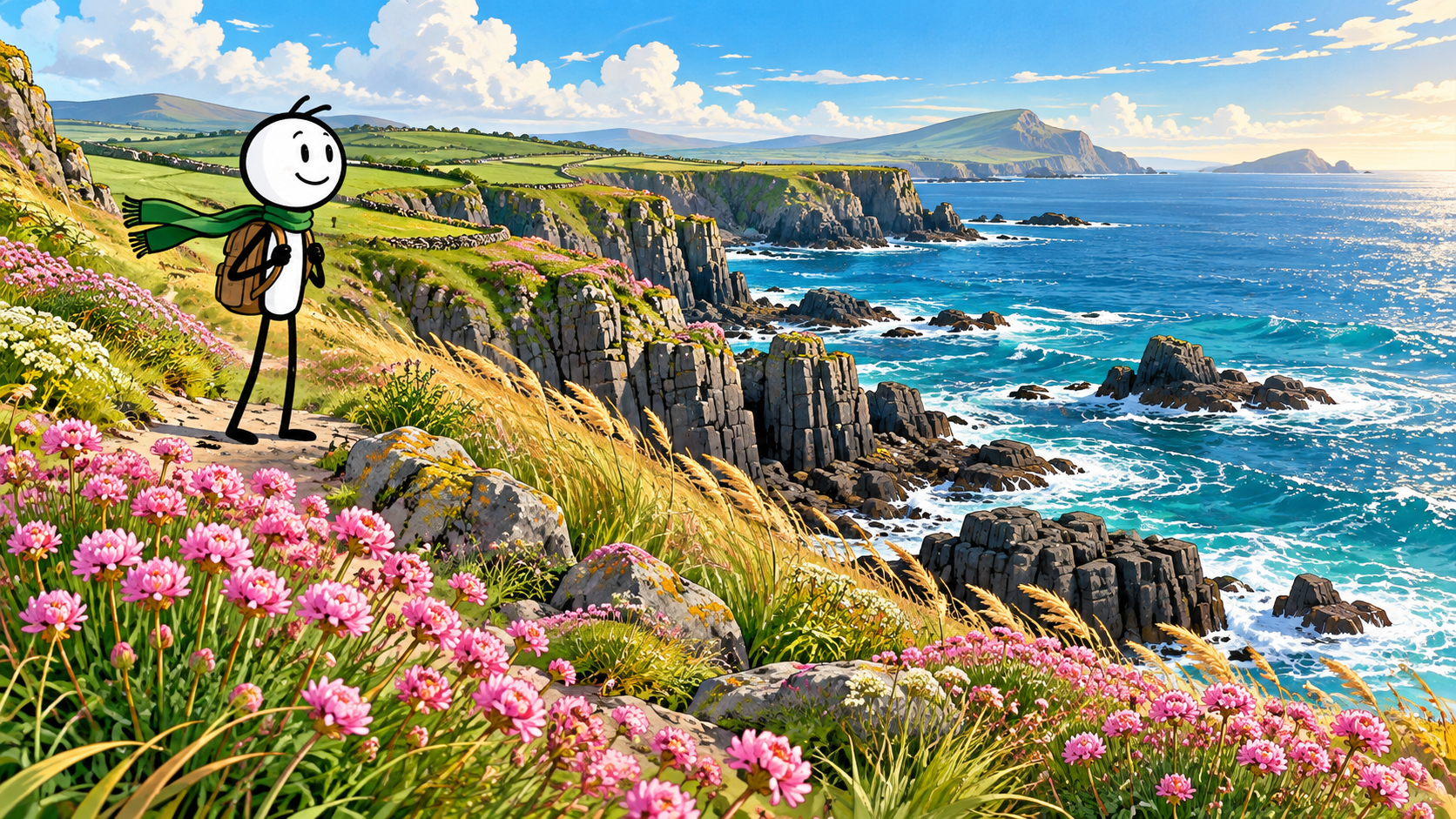
The Causeway is also a National Nature Reserve. DAERA identifies early-summer flowers including thrift, bird’s-foot trefoil, kidney vetch and spring squill. Around the cliffs, visitors may see buzzards or peregrine falcons; eider ducks and oystercatchers feed in sheltered bays. Sightings depend on season and conditions. [7]
Let the wildlife interrupt the rock story for a moment. Watch from a distance, leave flowers growing and give feeding birds space. If you visit outside the flowering season, the coastal habitats still deserve attention: the living landscape carries on after the postcard moment has passed.
Leave a memory rather than a mark
The National Trust asks visitors to stop inserting coins into cracks in the basalt. Corroding coins can expand, damage the surrounding rock and leave staining. A small token of a visit can therefore cause a lasting problem. Keep your coins in your pocket and leave the stones as you find them. [8]
Before travelling, check the National Trust’s current visitor information for parking, facilities and accessibility. Its guidance distinguishes the paid Visitor Experience from access to the outdoor World Heritage Site. Use current notices when choosing your route, and take care around wet stones, waves and cliff edges. [9]
Take the story with you
Once you understand the cooling lava, the columns become more interesting. Once you hear Oonagh’s trick, the same shore acquires a different kind of life. You can enjoy the story while recognising what the evidence tells us.
Which stays with you: the enormous “baby”, the ancient lava, or the traces of people working beside the sea? Share your thoughts on Cosy in Ireland, watch the companion Giant’s Causeway episode, and subscribe to Ireland: Fact or Folklore for more Irish places and the stories attached to them.