A few scratches on a stone can be easy to overlook. Look more closely, though, and those marks may preserve a person’s name from early medieval Ireland. Ogham offers a brief encounter with people whose conversations, work and daily worries have largely disappeared from the record.
This companion to our episode explores how the writing works, where folklore enters the story, and why a carved stone can have several different histories.
How do you pronounce ogham?
In modern Irish, ogham is pronounced OHM, with a long “oh” sound: /oːm/. The older spelling ogam represents a different pronunciation, /ˈoɣəm/, with a soft, voiced sound made towards the back of the mouth. The research project OG(H)AM explains this distinction. For reading this article aloud, OHM is the simplest consistent choice. [1]
An alphabet made for an edge
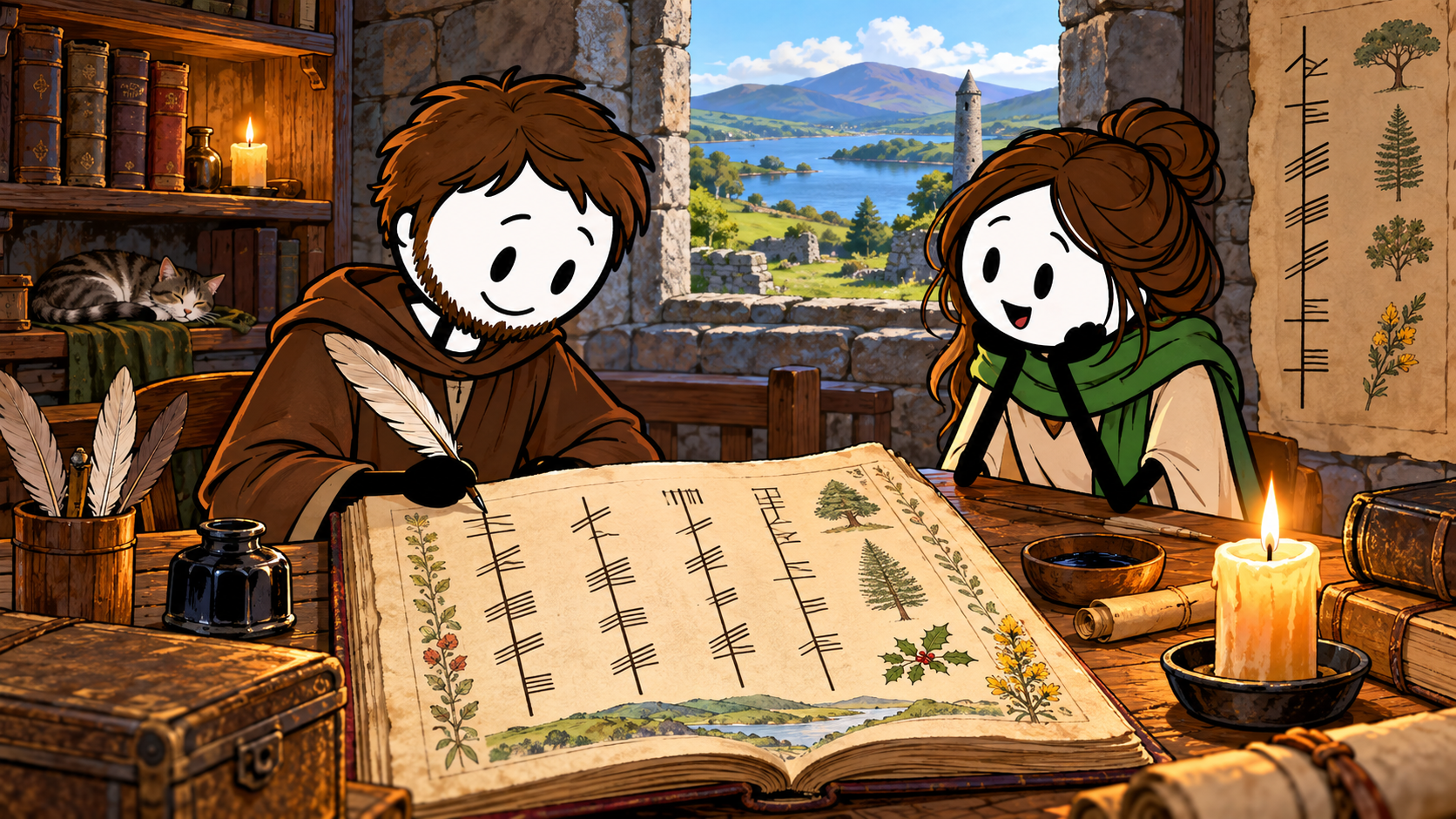
Ogham was devised for the sounds of an early stage of Irish called Primitive Irish. Its original alphabet contains twenty characters in four groups. Letters are formed from groups of strokes or notches, distinguished by their position against a central line. On a standing stone, an edge can supply that line. [2]
The earliest stone inscriptions are generally placed between the fourth and seventh centuries AD. Scholars use the language and spelling to help date them. An inscription commonly starts low on an edge and runs upwards; some continue across the top and down another side. Reading direction varies, so a published transcription is more reliable than guessing from a photograph. [3]
Names rather than full biographies
Many inscriptions record a personal name alongside a father’s name or another family connection. Most name men, so they show only part of the society around them. The formula MAQI indicates “of the son of”. It is a clue to relationships, rather than a sentence telling someone’s whole life story. [2]
Imagine finding just a name and a family connection in your own records. You might recognise the person without knowing their favourite food, sense of humour or greatest worry. That is part of ogham’s appeal: it brings individuals into view while leaving much of their experience beyond our reach.
A reused slab tells us about more than the first carving. It also belongs to the history of whoever selected it for a roof. We cannot know whether those builders recognised the inscription or what they thought about it. Their choice nevertheless helped the stone survive.
Ogham stones may have commemorated people or marked land and family claims. Their original purposes are not always certain, particularly when they have been moved. Calling every example a gravestone would go further than the evidence allows. [3]
Ogma and the folklore of writing
A medieval text known in English as The Book of Ogham credits the script to Ogma, a figure from Irish mythology. The story presents writing as a demonstration of his ingenuity and a form of communication for the learned. It tells us how a later writer imagined the power of knowledge; it does not identify a proven historical inventor. [5]
This is where fact and folklore meet without becoming interchangeable. The marks on the stones are material evidence. Ogma’s invention belongs to a literary account. Both are worth exploring, provided we explain what each can establish.
The alphabet whose key survived
Ogham knowledge continued in manuscripts. The Book of Ogham, preserved in the fourteenth-century Book of Ballymote, includes numerous variations and cryptic devices. Some change the shapes of letters; others rearrange or substitute them. Their practical purposes are not always known. [5]
These experiments explain why secret writing forms part of ogham’s history. They do not make every early inscription a cypher. In our episode title, “secret” also captures the experience of discovering writing that was hiding in plain sight.
Is ogham really a tree alphabet
The woodland connection is still something to enjoy. On an Irish walk, look for silver birch’s pale bark and triangular leaves, alder’s rounded leaves, and oak’s lobed leaves. Use a tree guide to check your identification. These are spotting suggestions, rather than a promise of what grows beside a particular ogham stone. [7]
The rock and the writing have different ages
A stone’s geological history begins long before anyone chooses to carve it. Ireland’s sandstones, for example, formed from sediment deposited in ancient landscapes. That history is separate from the date of an inscription, and ogham stones are not all made from the same rock. [8]
An older standing stone can also receive ogham centuries after it was first erected. To understand it, we need to ask when the rock formed, when the monument was placed, and when the letters were added. Those are separate questions. [3]
How researchers study faint marks
Digital recording gives researchers additional ways to examine inscriptions. Photogrammetry uses overlapping photographs to build a three-dimensional model. Other methods capture surface detail under changing light. These can help scholars inspect worn marks, although a digital model cannot make a missing letter certain. [9]
A closer look without leaving a mark
Enjoy ogham stones by observing and photographing them. Do not chalk the grooves, make rubbings or clean the surface. Check access arrangements and respect farmland and livestock. The Heritage Council’s Ogham Stone Code provides guidance for responsible visits. [3]
For a first encounter, the Dunloe group provides one documented example; the National Museum of Ireland also holds ogham stones. Check the relevant official website before travelling. [3,4]
Whose name would you preserve?
If you could leave one name for someone to read fifteen hundred years from now, whose would you choose? A few marks cannot preserve an entire life, but they can remind us that a person was here.
Watch Ireland’s Secret Writing in Stone — Ogham on Ireland: Fact or Folklore, and subscribe for more Irish history and folklore. Share the name you would preserve in the comments, then explore more companion pieces here on Cosy in Ireland.
Pronunciation guide
OHM is the source-supported modern Irish pronunciation. The remaining spellings below are practical English reading approximations, not phonetic transcriptions; local pronunciations can vary.
| Word or name | Reading guide |
| Ogham | OHM — long oh; modern Irish [1] |
| Ogma | OG muh — mythological figure |
| Dunloe | dun LOH |
| Souterrain | SOO tuh rain |
| Ballymote | BAL ee moht |
| Photogrammetry | foh toh GRAM uh tree |
| MAQI | Spell M A Q I when discussing a transcription |
References
References correspond to the bracketed numbers in the article. Web sources checked 3 October 2026.
1. OG(H)AM. About Ogham.
https://ogham.glasgow.ac.uk/index.php/about-ogham/
2. Maynooth University Department of Early Irish (2024). Ancient Writing in the Gaelic World The Ogam Script and Ogam Texts.
https://ogham.glasgow.ac.uk/wp-content/uploads/2024/09/Poster-on-Ogam.pdf
3. White, Nora (2021). Ogham Stones in Ireland. The Heritage Council.
https://www.heritagecouncil.ie/content/files/Ogham-Stones.pdf
4. Heritage Ireland. Dunloe Ogham Stones.
5. OG(H)AM (2022). In Lebor Ogaim The Book of Ogam.
https://ogham.glasgow.ac.uk/index.php/2022/06/29/in-lebor-ogaim-the-book-of-ogam/
6. Hayden, Deborah and David Stifter (2022). Ogam and Trees. OG(H)AM.
https://ogham.glasgow.ac.uk/index.php/2022/12/20/ogam-and-trees/
7. Woodland Trust. How to Identify Trees A Simple Guide.
https://www.woodlandtrust.org.uk/trees-woods-and-wildlife/british-trees/how-to-identify-trees/
8. Geological Survey Ireland. Ireland through geological time.
9. Kasten, Megan (2022). Three Approaches to Digital Imaging. OG(H)AM.
https://ogham.glasgow.ac.uk/index.php/2022/03/28/digital-imaging-techniques-used-to-record-ogham-at-the-national-museum-of-ireland/