The banshee: a voice of mourning
The banshee is often presented as a screaming attacker. In many recorded Irish traditions, however, she announces or mourns a death associated with a family. Her cry is an omen within the story, rather than evidence that she causes the death. The Irish name bean sí is commonly understood as a woman of the fairy world.
Her appearance and family connections vary. Accounts collected in different communities describe different women and name different families. The familiar claim that she follows only surnames beginning with O or Mac is too tidy to represent every local tradition. A Galway account in the National Folklore Collection, for instance, names Donohues and Hayeses. [1]
These stories are also family histories. When someone recalls a grandmother hearing a cry before a relative died, we learn about memory, grief and the way a household understood loss. Recording the account preserves that experience; it does not establish a supernatural cause.
One especially memorable account concerns Bun-na-Margie Friary near Ballycastle in County Antrim. A pale apparition on the ruins was investigated and identified as a white goat grazing on a wall. The explanation was preserved alongside accounts of belief. Folklore includes sceptics, humour and corrections too. [2]
The useful question is not always “Was it a ghost?” Sometimes it is “Who told the story, and what did it mean to them?”
The Sheela-na-gig: real stone, uncertain meaning
A Sheela-na-gig is a carved female figure displaying her genitals. That anatomical feature is central to identifying this type of sculpture. Many surviving examples are associated with medieval buildings, including churches and castles. Examples also occur outside Ireland. [3, 4]
The objects are real. Their original purposes are disputed. Interpretations include protection against evil, warnings concerning lust, and associations with fertility or childbirth. These readings need to be assessed against the setting and history of each carving. A medieval sculpture is not, by itself, proof of an uninterrupted ancient goddess tradition. [4]
Where was a figure originally placed? Could visitors see it? Was it moved or built into a later wall? Those practical questions may be more useful than choosing the most dramatic explanation.
A small detail can tell a larger story. The National Museum of Ireland describes a County Tipperary example carved on sandstone, with mortar remaining on its sides. That mortar provides evidence that the block once formed part of a larger masonry structure. It does not explain the figure’s meaning, but it helps reconstruct its physical history. [5]
There is geology here as well as archaeology. Grain, weathering and exposure influence what remains visible on a stone surface. A missing detail may have eroded away; it should not be replaced with an explanation merely because we would like one.
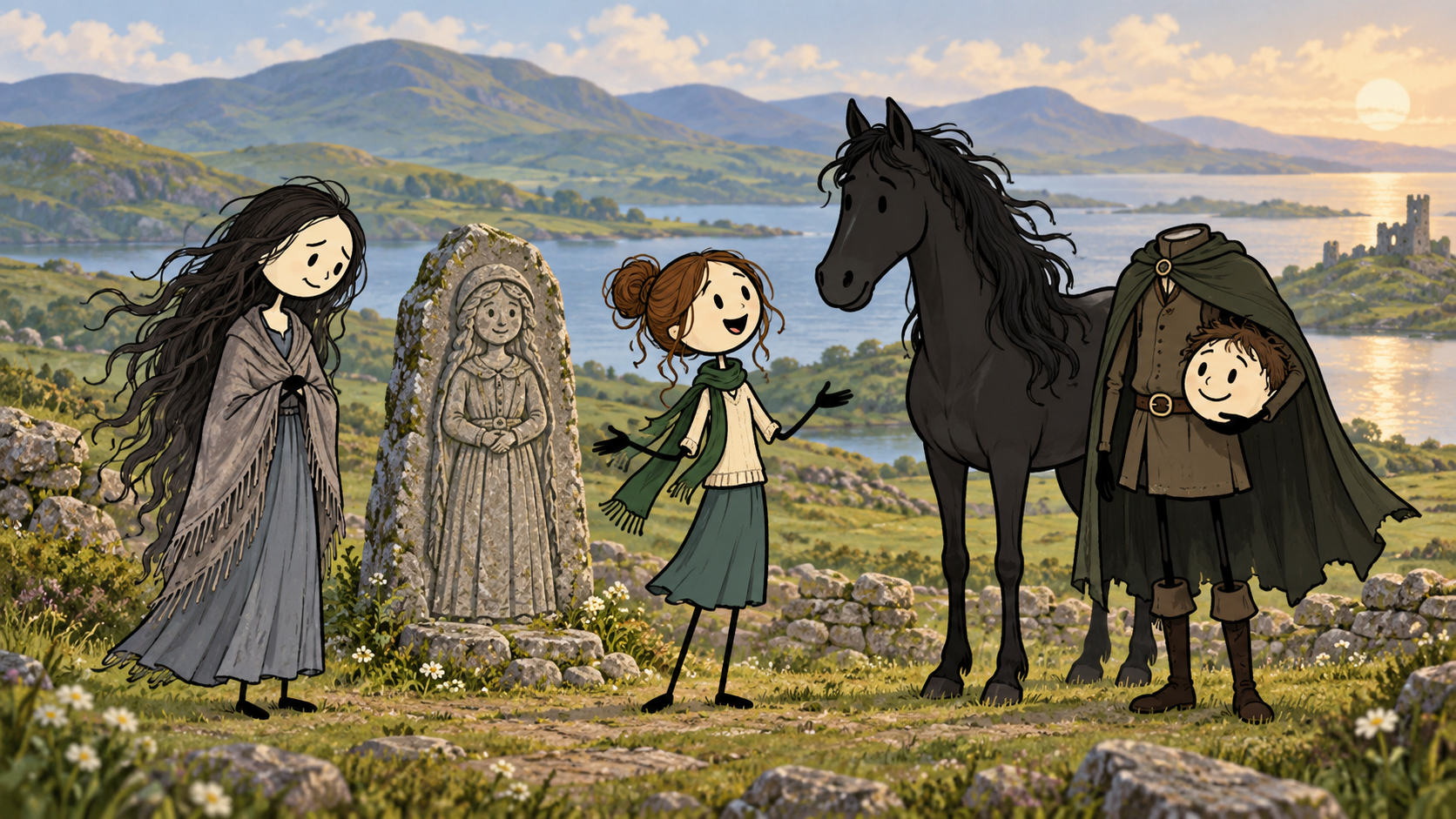
The clothed carvings in this episode’s illustrations are artistic adaptations. They are not accurate archaeological depictions of Sheela-na-gigs. For the defining features of authentic examples, consult the museum photographs and object records. [3]
The púca: the lift home you might regret
Púca is also written pooka or puka in English. Horse stories are particularly memorable: an apparently manageable animal offers a traveller an easier journey, then carries them through a night of confusion. A Carlow account records an enchanted horse, a punishing ride and a landing among thorny vegetation. The teller also recalls reluctance to mount familiar horses after dusk. [6]
But the púca is not confined to one role. A Schools’ Collection account about a mill on Inch Island in Lough Gowna describes unseen work associated with a supernatural miller. Grain was processed until local people left a gift of clothes, after which the help stopped. The story makes everyday labour, and the uncertainty of dealing with a mysterious helper, part of the supernatural world. [7]
Harvest traditions give the púca another job. The National Museum of Ireland records Halloween warnings about the creature spoiling wild fruit. This belongs to seasonal folklore; it is not a reliable test of whether a berry is safe to eat. [8]
The setting matters. A ditch, hedge or stream that is easy to navigate in daylight can become difficult after dark. The suggestion that these surroundings help a story feel convincing is an interpretation, not a complete explanation of the tradition’s origins.
The Dullahan: a frightening beginning, an unexpected ending
The headless rider is now one of Ireland’s most recognisable supernatural images. Older material, however, offers a range of headless apparitions and encounters rather than one fixed monster description.
In Thomas Crofton Croker’s nineteenth-century collection, Charley Culnane encounters a headless horseman on a night journey in County Cork. Their meeting becomes a test of riding and courage. The apparition approves of Charley and promises support before disappearing. This is a brief summary of a literary tale, not a verified encounter. [9]
That reversal is worth remembering. Irish supernatural storytelling can move between fear, comedy and unexpected companionship. A terrifying appearance does not always tell you how the story will end.
Croker’s collection also discusses the death coach as an omen of death or misfortune. Later archive records preserve local coach traditions. A Wexford account recorded in August 1937 describes a black coach travelling between Carnross and Cushenstown, with headless horses and a headless driver. The unsettling detail is that it passes silently. [10]
An Abbeyleix account instead describes furious driving and a coachman wearing black with a tall hat. Its description of the driver differs from the Wexford account. Variation is part of the evidence, rather than a mistake that needs tidying away. [11]
What these sources can — and cannot — tell us
A carving can reveal workmanship, material and traces of a building history. A collected account can preserve what someone reported, remembered or believed. A literary tale can show how a writer shaped supernatural material for readers. None automatically answers every question about an earlier community.
The Schools’ Collection was assembled in 1937 and 1938, with schoolchildren gathering folklore from people around them. Its pages preserve conversations and local memories. A twentieth-century recording directly documents what was collected then; a claim that a detail reaches unchanged into ancient Ireland needs additional evidence. [12]
My reading of these four figures is that they repeatedly draw attention to uncertain boundaries: family life and loss, daylight and darkness, harvest and winter, the familiar road and the unexpected journey. That is a connecting interpretation, not a claim that all four share one origin.
Places and small discoveries to explore
At the Hill of Tara in County Meath, Heritage Ireland identifies a weathered carving on the taller of two churchyard standing stones as believed to be a Sheela-na-gig. The qualification matters: worn carvings can be difficult to identify. Use the official visitor information when planning a trip, and observe stones without rubbing, climbing or disturbing them. [13]
From home, explore the National Museum of Ireland’s online Sheela-na-gig gallery, then compare a museum object record with a folklore transcription on Dúchas. Notice how differently the two sources describe their evidence. Museum labels can identify material and provenance; archive entries can identify collectors, informants and places. [3, 12]
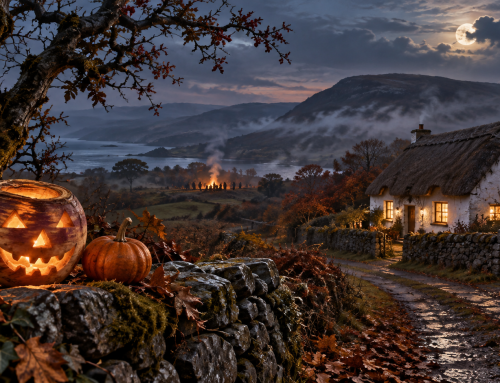
On an autumn lane, look for bramble leaves, hawthorn berries, ivy flowers and birds using the hedgerow. These living surroundings connect the stories with the working countryside. Watch without disturbing wildlife and leave unfamiliar plants untasted. If you hear an unusual call, allow room for an ordinary explanation — our white goat has already made that point.
A pronunciation guide
| Name | Approximate English narration guide |
| Banshee | BAN-shee |
| Bean sí | ban shee |
| Sheela-na-gig | SHEE-la nuh gig |
| Púca / pooka | POO-kuh |
| Dullahan | DULL-uh-han |
| Dúchas | DOO-khus |
| Samhain | SOW-in; first syllable rhymes with cow |
These are practical approximations for English narration. Irish-language and regional pronunciations vary.
Keep a story in conversation
Ask someone who remembers a local tale where they heard it, roughly when, and whether other versions were told. Record the place, the storyteller’s name and the circumstances. Ask permission before recording or publishing their words, and distinguish what they experienced from what they heard from someone else.
A family story need not prove the existence of an apparition to be worth preserving. It can tell us about work, worry, humour, place and the people who came before us.
Which would you investigate first: the mourning banshee, the mysterious stone carving, the unpredictable púca or the headless rider? Share your choice and your local stories with Cosy in Ireland, and subscribe to Ireland: Fact or Folklore for the next episode. You can explore more companion pieces here on Cosy in Ireland.
And if a very quiet horse offers you a lift tonight… perhaps finish the walk.
References and further reading
1. National Folklore Collection, UCD / Dúchas. “About the Banshee”, Abbey (Naomh Feichín), Schools’ Collection.
https://www.duchas.ie/ga/cbes/4583320/4579382/4593137?transcribe=true
2. National Folklore Collection / Dúchas. “The Banshee”, Main Manuscript Collection CBÉ 0323, Part 1. Includes the Bun-na-Margie goat account.
https://www.duchas.ie/en/cbe/9000316/7156472/9072569?transcribe=true
3. National Museum of Ireland. “The Sheela na Gigs in the National Museum of Ireland’s reserve collection”. Authentic photographs contain anatomical imagery.
https://cms.museum.ie/en-IE/Collections-Research/Collection/The-Sheela-na-Gigs-in-storage
4. British Museum. “Sheela-na-Gig”, object interpretation hosted by Google Arts & Culture.
https://artsandculture.google.com/asset/sheela-na-gig/nAHF99mSevHHVw?hl=en
5. National Museum of Ireland. “Sheela na Gig, Co. Tipperary”, registration 2004:163. Sandstone and mortar evidence.
https://cms.museum.ie/en-IE/Collections-Research/Collection/The-Sheela-na-Gigs-in-storage/Artefact/Sheela-na-Gig%2C-Co-Tipperary/9fb559c0-dc33-4a4e-87bd-f269e89bff2a
6. Dúchas. “The Púca”, Main Manuscript Collection CBÉ 0462, Part 3, c. January 1938.
https://www.duchas.ie/ga/cbe/9000989/7219079/9090174?transcribe=true
7. Dúchas. “The Cornmill on Inch Island”, Schools’ Collection CBÉS 0763, pp. 049–050. Locate using the púca transcription search below.
https://www.duchas.ie/en/cbes/transcripts?Page=6&PerPage=20&SearchLanguage=en&SearchText=puca
8. National Museum of Ireland. “Ghost turnips, the púca, fortune-telling and evil abductions…how our ancestors inspire our Halloween celebrations today”.
https://source.museum.ie/en-IE/News/2023/Ghost-turnips%2C-pucas%2C-fortune-telling-and-evil-abd
9. Thomas Crofton Croker. Fairy Legends and Traditions of the South of Ireland. Gutenberg ebook 39752; “The Dullahan” section, especially “The Headless Horseman” and section note.
https://www.gutenberg.org/files/39752/39752-h/39752-h.htm
10. Dúchas. “The Headless Coach”, Main Manuscript Collection CBÉ 0406, Part 5, p. 0289; Clongeen, County Wexford, recorded 16 August 1937.
https://www.duchas.ie/en/cbe/9000953/7260082/9083124
11. Dúchas. “The Headless Coach”, Abbeyleix Convent, Schools’ Collection CBÉS 0832, p. 063.
https://www.duchas.ie/ga/cbes/4770025/4767599/4786538
12. Dúchas / National Folklore Collection. The Schools’ Collection: collection information and search.
https://www.duchas.ie/en/cbes
13. Heritage Ireland. Hill of Tara highlights: churchyard standing stones and possible Sheela-na-gig.
https://heritageireland.ie/visit/places-to-visit/hill-of-tara/highlights/
Prepared 6 October 2026. Archive accounts are evidence of recorded traditions, not verification of supernatural events. This article uses original summaries rather than reproducing source passages.