Did Halloween really begin in Ireland? Discover the evidence behind Samhain, Rathcroghan, Oweynagat, the Hill of Ward and Ireland’s carved turnip tradition.
Before the pumpkin, there was a turnip face glowing in the dark. Smaller, harder to carve and often far less cheerful, it offers a useful way into Halloween’s Irish history. But how far back can that face take us?
There is no archaeological discovery that marks the first Halloween, no surviving druid’s handbook and no single Irish ceremony that can be traced unchanged into pumpkin carving and trick-or-treating. Instead, the evidence comes in layers: the Gaelic festival of Samhain, medieval stories, ancient ceremonial landscapes, Christian holy days, folk customs, migration and reinvention.
The most revealing clues are sometimes the smallest: a remembered game, a homemade disguise or a lantern sent to a museum. They help us understand Ireland’s place in Halloween without claiming that one community invented every part of it.
Start with the name: Halloween
The word Halloween is not an ancient Irish word. It comes from All Hallows’ Even — the evening before All Hallows, or All Saints’ Day.
That matters because the modern festival cannot simply be described as an unchanged pagan celebration. Its familiar name belongs to the Christian calendar. Yet the date also sits beside an older Gaelic seasonal boundary: Samhain.
Rather than imagining one festival replacing another overnight, it is more useful to picture traditions meeting, overlapping and changing over centuries.
What was Samhain?
Samhain marked the opening of winter in the medieval Gaelic calendar. Early Irish literature places it among the major seasonal divisions of the year.
For farming communities, this was not an abstract date. Livestock returned from summer grazing. Winter food had to be judged and stored. Animals that could not be supported through the colder months might be slaughtered. Darkness arrived earlier and travel became harder.
That gives Samhain a very human meaning. It stood at a point when households had to look at what they possessed, what they needed and whether they were ready for winter.
And seasonal boundaries are excellent places for stories to gather.
The dead man at Cruachan
One of the most memorable Samhain stories is The Adventure of Nera. It begins at Cruachan, the royal centre of Connacht, where Nera accepts a challenge involving the body of a recently hanged man.
The corpse moves. Nera is drawn into a supernatural journey, encounters an otherworldly host and experiences time behaving in ways it should not.
This is not an eyewitness account of an Iron Age Samhain ceremony. It is medieval literature. But that distinction does not make it unimportant. It shows that Irish storytellers associated Samhain with disturbed boundaries between ordinary life and the Otherworld.
Rathcroghan: where story meets landscape
Cruachan is associated with Rathcroghan in County Roscommon, one of Ireland’s great archaeological landscapes. More than 240 recorded archaeological sites occupy the area, including mounds, enclosures, burial monuments, ringforts, standing stones and linear earthworks.
Archaeology confirms that this was an important ceremonial and political landscape over a very long period. What archaeology cannot do is attach the label ‘Halloween’ to an ancient layer of soil.
This is an important difference. The archaeology establishes the significance of the landscape. Medieval literature supplies stories connecting Cruachan with Samhain and the Otherworld. Together they create a compelling cultural connection — but not a certificate saying ‘Halloween began here’.
Oweynagat: Ireland’s famous doorway to the Otherworld
Then there is Oweynagat, the Cave of the Cats, on the Rathcroghan landscape.
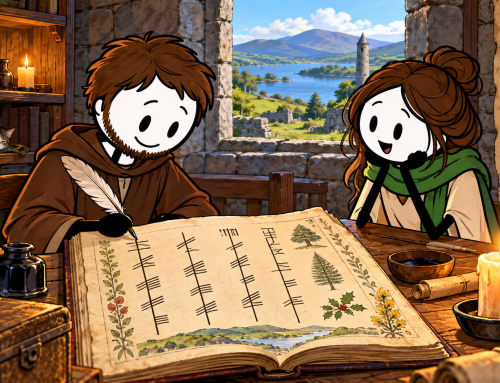
The entrance combines an early medieval stone-built passage with a natural limestone cave. Ogham inscriptions survive there, while medieval and later stories connect the place with beings emerging from the Otherworld.
Its geology helps explain its atmosphere. Limestone slowly dissolves as slightly acidic rainwater passes through it, opening cracks and cavities underground. Water can disappear beneath the land and cold air can emerge from darkness.
Place such an opening among ancient burial monuments and it is easy to understand why stories about passages between worlds might attach themselves to it. That is not proof of a particular prehistoric belief. It is an example of landscape, geology and imagination reinforcing one another.
Look for the October landscape
If you visit the area in autumn, the folklore is not the only thing worth watching. Hawthorn may carry red haws and blackthorn dark sloes. Hooded crows and ravens can be seen across farmland, while the shortening days change the character of the landscape.
These plants and animals do not prove old supernatural traditions. They do something more useful for a visitor: they put the stories back into the physical season that helped produce them.
Tlachtga and the Hill of Ward
Another place frequently called the birthplace of Halloween is Tlachtga, the Hill of Ward, near Athboy in County Meath.
Modern archaeological work shows that this was a complex site used and remodelled over many centuries. Excavation has produced large quantities of animal bone, charred plant remains, evidence of metalworking, human remains and a late tenth-century silver-coin hoard.
That is strong evidence for gathering, consumption, activity and continuing importance. It is not, by itself, proof of Halloween.
The detailed story that druids gathered at Tlachtga at Samhain and that other fires were rekindled from a central sacred flame is associated with Geoffrey Keating, writing in the seventeenth century — long after the pagan period being described.
Perhaps his account preserved older tradition. Perhaps later memories became attached to an already ancient site. Archaeology cannot decide that question on its own.
Was Samhain really the ‘Celtic New Year’?
This is one of the phrases most often repeated in accounts of Halloween. It sounds authoritative: Samhain was the Celtic New Year and a great ancient feast of the dead.
The evidence is less tidy. Historian Ronald Hutton has challenged the certainty with which these ideas are repeated, arguing that evidence for a universal ancient pan-Celtic New Year is indirect and that claims for a general pre-Roman feast of the dead are particularly weak.
That does not reduce Samhain to a myth. Medieval Irish sources clearly make it an important seasonal threshold. The problem comes when evidence from different places and centuries is squeezed into one supposedly universal ‘Celtic’ religion.
So where did familiar Halloween customs come from?
Modern Halloween looks less like a single surviving ritual and more like a river fed by several tributaries.
Gaelic tradition contributed the winter threshold, seasonal gatherings and powerful stories about supernatural encounters. Medieval Christianity contributed All Hallows, All Souls, vigils and remembrance of the dead. Later Irish and Scottish communities added and reshaped local customs involving disguise, visiting houses, games, food and fortune-telling.
The fact that customs varied from county to county is not a weakness in the evidence. It is exactly what we should expect from traditions being carried by ordinary people rather than copied from a rulebook.
Before the pumpkin came the turnip
One of the clearest links between older Irish Halloween customs and the modern festival is wonderfully ordinary: the turnip.
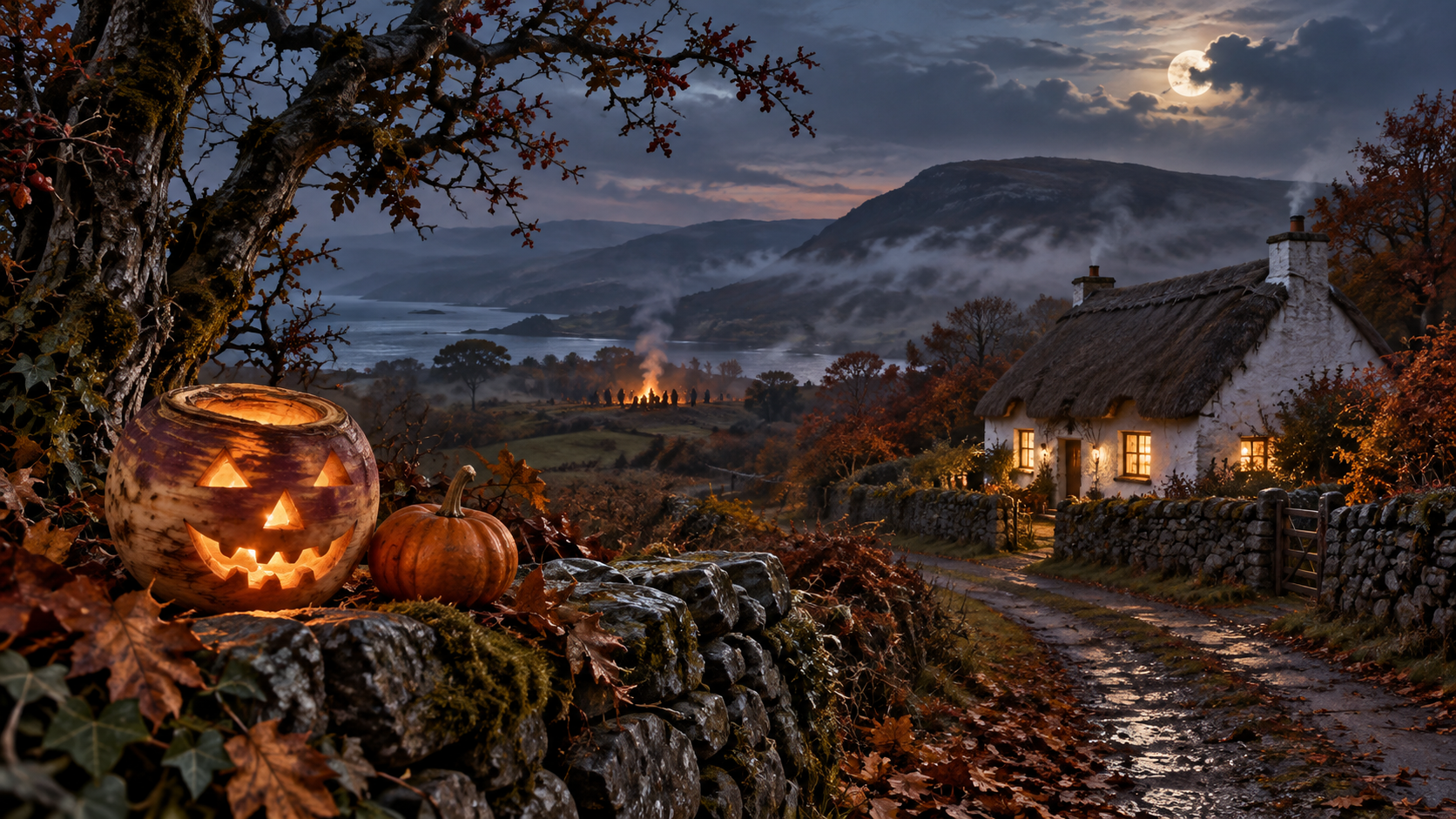
Turnips and swedes were hollowed and carved into lanterns in Ireland and Scotland. Anyone who has tried to carve one will appreciate why the pumpkin eventually won. A turnip is smaller, harder and considerably less cooperative.
In 1943, schoolteacher Rois Ní Braonáin, who was teaching near Fintown in County Donegal, sent a turnip lantern to the National Museum of Ireland. She reported that this was the type made locally around 1900. Museum artist Eileen Barnes created and painted a plaster model, preserving the appearance of an object that would otherwise decay.
That recorded history matters. It gives us a place, a remembered period and people connected with the custom. It supports local turnip carving around 1900; it does not prove that the same lanterns were carved in the Iron Age.
When Irish and Scottish migrants carried customs across the Atlantic, pumpkins offered a larger and softer material for carving. North America then transformed and commercialised Halloween before popular culture carried that version around the world — including back across the Atlantic.
The familiar pumpkin lantern took shape in North America, but the custom of carving a frightening face into a lantern has roots across the Atlantic.
Fact or Folklore?
FACT: Samhain was an important Gaelic seasonal boundary associated with the beginning of winter.
FACT: Medieval Irish literature connects Samhain with supernatural danger and journeys into the Otherworld.
FACT: Rathcroghan and Tlachtga are genuine ancient landscapes of exceptional archaeological importance.
FACT: Irish folk traditions included disguise, visiting houses, divination, seasonal games and carved turnip lanterns.
FOLKLORE OR OVERSTATEMENT: Archaeologists have discovered the exact place where Halloween was invented.
FOLKLORE OR OVERSTATEMENT: Every modern Halloween custom is a direct survival from pagan Samhain.
FOLKLORE OR OVERSTATEMENT: We know that every ancient Celtic community celebrated an identical New Year feast of the dead.
The better answer
Ireland probably did not ‘invent Halloween’ in the way a person invents a machine or a writer creates a story.
Something more interesting happened.
Ireland preserved one of the festival’s deepest cultural roots: Samhain, a winter threshold surrounded by powerful medieval stories. Irish communities also carried forward customs involving disguise, divination, visiting and carved lanterns. Christianity, neighbouring traditions, migration and America all added further layers.
So the next time you see a pumpkin glowing in a window, imagine what stands behind it: a hard Irish turnip; children going from door to door in disguise; a medieval manuscript telling of Nera following the dead; cattle returning for winter; ancient mounds under wet grass; and a limestone cave breathing cold air into the October night.
We may never identify one first Halloween. What we can follow is the work of people who carried its stories and customs forward.
A child remembering a game, a teacher saving a lantern and an artist preserving its shape all belong to that history. Your own family memories may hold another small part of it.
Preserve your Halloween memories
Ask a relative or neighbour about a Halloween they remember. Let them tell the story in their own words, then note the custom, the place, the approximate year and who taught it to them. Ask permission before publishing their name, photograph or recording.
Useful questions are simple: What did you wear? What happened when you knocked at a door? What food or games do you remember? Was there a story that frightened you? Did anyone carve a turnip?
Keep the difference between memory and proof clear. “My grandmother remembered doing this in Donegal in the 1940s” is a valuable family account. It does not establish that the custom began there or had remained unchanged for centuries.
For example, your note might read: “Custom: singing at neighbours’ doors. Place: ____. Approximate year: ____. Remembered by: ____. Learned from: ____. Their words: ____.” Keep the original wording alongside any summary.
Share one custom in the comments, with the place and an approximate decade if you know them. Different versions are worth recording too; variation is part of how living traditions work.
Listen to the full investigation
The Ireland: Fact or Folklore episode, Did Ireland Invent Halloween? The Haunting Truth Behind Samhain, follows the evidence in greater detail, including the archaeology of Rathcroghan and Tlachtga, the story of Nera, Oweynagat and the journey from carved turnips to modern Halloween.
If you enjoyed this companion piece, listen to the full episode and join Ireland: Fact or Folklore as we keep testing Ireland’s best-known stories against history, archaeology and the landscape itself.
Source for the ghost turnip
National Museum of Ireland, Ghost turnip, collection F1943.350. The museum records the donor, local date and Eileen Barnes’s plaster model. https://cms.museum.ie/en-IE/Collections-Research/Collection/Top-things-to-see-in-the-Irish-Folklife-Collection/Artefact/Ghost-turnip/b202e8ea-0728-4b3d-b0f1-82660fe45ce9