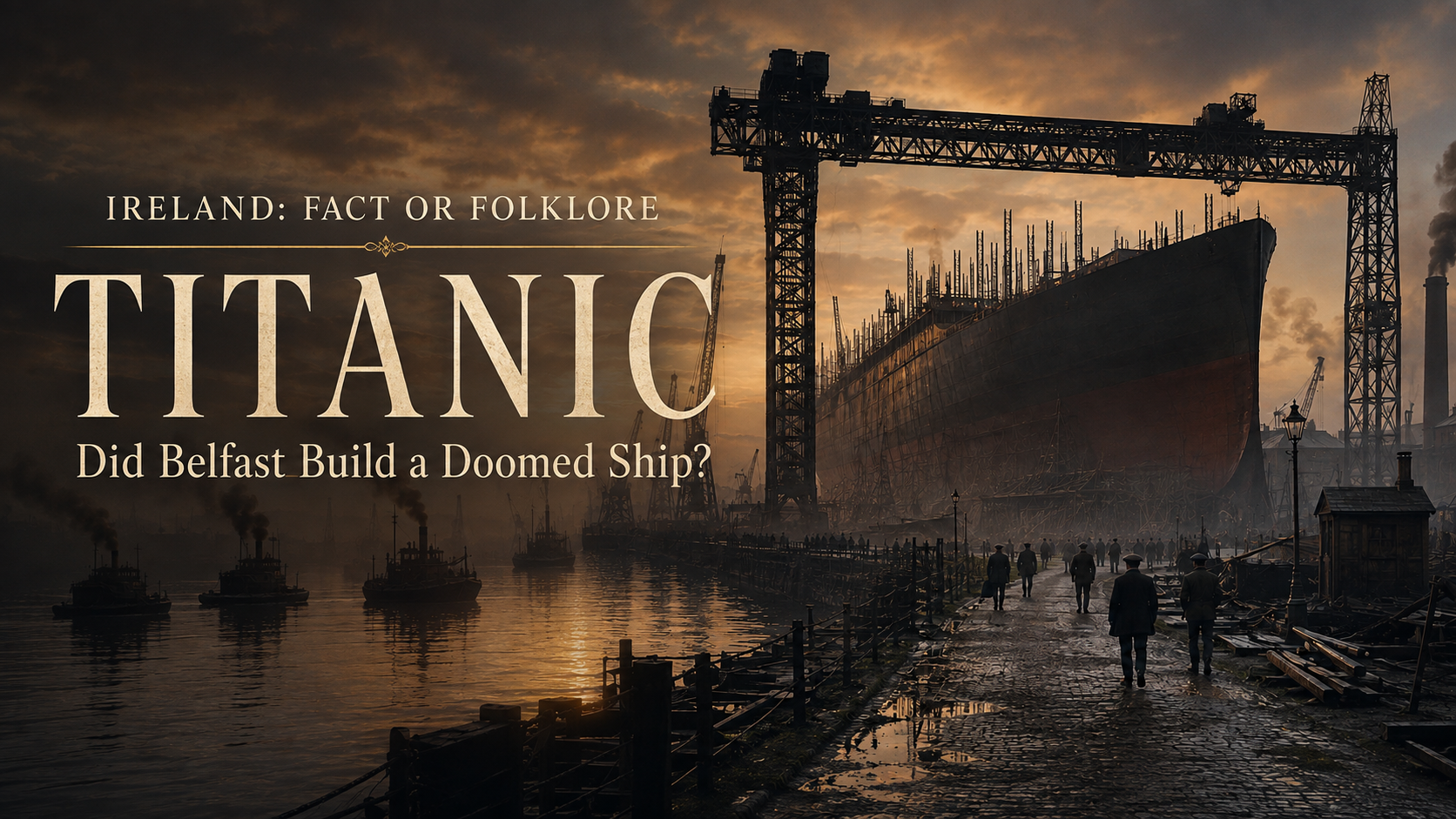
THE EVIDENCE ROOM
If Belfast Built the Titanic to Fail,
What Would Prove It?
A shipyard case file that begins where the podcast ends
COSY IN IRELAND • COMPANION TO IRELAND: FACT OR FOLKLORE
“A disaster may expose weaknesses without proving that its builders expected catastrophe.”
The document that was never found
Imagine an archive box being opened in Belfast. Inside is a Harland & Wolff memorandum dated early 1912. It records failed rivet tests, predicts that flooding will pass over Titanic’s bulkheads, and warns that the lifeboat provision cannot evacuate a full ship. Across the bottom, a director has written: ‘Sail her anyway. The cost of alteration is too high.’
That single sheet would transform the case against the shipyard. It would not prove every later decision was Belfast’s fault, but it would show knowledge, power and a conscious refusal to act.
There is one difficulty: no accepted document of that kind has been found. The surviving evidence shows debate, limits and assumptions, but not a secret Belfast plan to launch a death trap. So the useful question is not whether Titanic contained weaknesses. Every complex machine does. The question is what the builders knew, what they could reasonably foresee, and which decisions were actually theirs.
Case rule: responsibility needs knowledge and control
A defect discovered after a disaster does not automatically prove negligence. A fair historical case needs more than hindsight. It must establish what information existed before the voyage, who possessed it, whether a safer practical option was available, and who had authority to choose it.
THE TEST: known danger + workable alternative + power to act + failure to act. Hindsight alone is not a verdict.
Clue one: the paper ship
Before Titanic became steel, she existed as drawings, calculations, specifications and contracts. Those records are vital because they separate the builder’s choices from the owner’s instructions and the regulator’s rules. Plans can show the height of bulkheads, the arrangement of watertight compartments and the space allowed for lifeboats. Correspondence can show whether an objection was raised, rejected or never imagined.
The Olympic-class design incorporated sixteen main watertight compartments and remotely operated watertight doors. It was serious contemporary engineering, but the divisions did not form sealed boxes reaching to the highest decks. Once the bow sank sufficiently, water could spill over successive bulkheads. The limitation was real; the harder question is whether the collision scenario that exploited it should have been treated as reasonably foreseeable in 1912.
The strongest case against Belfast would therefore be a dated calculation or warning showing that Harland & Wolff expected a survivable collision to become uncontrollable through progressive flooding, followed by a decision not to alter the design. Without such a record, the design limit is evidence of vulnerability, not proof of deliberate recklessness.
Clue two: the metal under the microscope
Titanic’s wreck made it possible to test fragments of hull material that the 1912 investigators could not examine. NIST metallurgist Tim Foecke reported elevated slag in recovered wrought-iron rivets and proposed that some fasteners may have lost their heads or pulled free as the iceberg forced hull plates apart. This gives the material case genuine weight.
It does not settle the trial on its own. Samples recovered from the seabed represent only a fraction of the millions of fasteners used. Rivets varied by location and manufacturer, and the collision imposed violent, unusual loading. A microscopic weakness can help explain the route by which water entered without proving that normal construction made loss inevitable.
To convict the yard on workmanship, we would want matched evidence: procurement records specifying inferior material, rejected inspection results, surviving samples tied to exact hull locations, and proof that managers knew those rivets fell below the accepted standard of the day. The microscope tells us how metal may have behaved. It cannot, on its own, tell us what a Belfast foreman knew.
Clue three: the lifeboat decision had several addresses
Titanic carried twenty lifeboats, far fewer than required for everyone aboard at full capacity. That fact is not folklore and should not be softened. Yet responsibility does not sit neatly at one drawing desk.
The ship complied with the Board of Trade rules then in force. Those rules had failed to keep pace with the increasing size of liners. White Star Line owned and operated Titanic; the Board of Trade certified her; Harland & Wolff built the vessel. Alexander Carlisle, who had been closely involved with the Olympic-class project, later gave evidence about lifeboat arrangements and additional capacity. The surviving testimony reveals a system in which legal compliance could substitute for asking what a complete mid-ocean evacuation would require.
A decisive shipyard document would need to show more than space for extra boats. It would need to establish that the builder controlled the final number, clearly understood the likely loss of life, and rejected a practical alternative for an improper reason. The historical evidence instead spreads authority across builder, owner and regulator. The shortage was a grave failure of the system; calling it simply a Belfast workmanship fault hides where decisions were made.
Clue four: the moment the ship changed hands
Titanic completed sea trials on 2 April 1912 and was handed over before sailing to Southampton. This transfer matters. A shipbuilder remains responsible for the work it delivered, but it does not choose every action taken during service.
The British inquiry found that the loss followed a collision with an iceberg brought about by excessive speed. Its conclusions can be debated, but the division of control is plain: Harland & Wolff did not set Titanic’s speed on 14 April, decide how ice warnings were handled, organise the evacuation or lower boats with empty places.
Good design should allow for human error. That principle keeps Belfast within the case, because the ship’s subdivision determined what happened after impact. But it also prevents the case from becoming a convenient story in which a city’s workers are blamed for choices made hundreds of kilometres (miles) away and after delivery.
The sister-ship test
Olympic is the awkward witness for anyone claiming Titanic was inevitably doomed from launch. Built in the same Belfast yard to a closely related design, she completed a long commercial and wartime career before leaving service in 1935. After Titanic sank, Olympic was modified, including safety improvements, so she is not a perfect laboratory control. She is still powerful comparative evidence.
If the basic design and shipyard method guaranteed catastrophe, a near-sister surviving hundreds of crossings becomes difficult to explain. Olympic cannot acquit every rivet or every design choice. She does show that the industrial system which produced Titanic could also produce a durable working liner.
Britannic supplies a second warning about simple verdicts. She incorporated safety changes but was lost during the First World War after striking a mine. Similar ships can meet different fates because design, damage, operation and circumstance interact.
The workers were not the boardroom
The phrase ‘Belfast built Titanic’ can make thousands of people sound like one decision-maker. They were not. Riveters, fitters, platers, joiners, electricians and labourers worked within a hierarchy. Many had no power over specifications, regulations, routes or sailing orders. The yard itself was also marked by dangerous labour, class inequality and sectarian exclusion; its workforce should not be romanticised into a single happy family.
Alfred Fleming Cunningham offers a more human measure. The young Belfast fitter sailed as one of Harland & Wolff’s nine-member guarantee group, sent to observe the new ship and correct faults. None survived. Their presence does not prove Titanic was flawless, but it is difficult to reconcile with the idea that those nearest the work knowingly expected the vessel to fail on her maiden voyage.
People-centred history follows authority as carefully as it follows grief. A worker may create part of a ship without choosing the rule, budget or voyage that shapes its risk. Responsibility should rise towards those who knew more and could decide more.
What would change the verdict?
The Belfast case is not closed to new evidence. A newly catalogued letter, inspection ledger or test report could alter how historians understand the decisions made before launch. The most persuasive discovery would connect several parts of the case rather than isolate one dramatic flaw.
- A dated Harland & Wolff warning that identified a fatal flooding sequence before delivery.
- Test records proving that critical material failed the yard’s own accepted standard and was knowingly used.
- Correspondence showing that the builder controlled and rejected adequate lifeboat provision despite a clear safety warning.
- Evidence that defects were concealed from White Star, surveyors or the Board of Trade.
Any such find would need secure provenance, expert examination and corroboration. A striking quotation detached from its archive file would not be enough. The object still needs an address; the document needs a chain of custody and a place within the decisions around it.
The Evidence Room verdict
CURRENT VERDICT: Titanic contained serious safety limitations, but the surviving evidence does not show that Belfast knowingly built a ship doomed to sink.
Some rivets may have influenced how the iceberg damage spread. The watertight subdivision could not contain flooding across too many forward compartments. Lifeboat provision was disastrously inadequate for the number aboard. These are not excuses; they are parts of the case.
But a historical verdict must distinguish contribution from inevitability and workmanship from authority. Titanic passed through a chain of design assumptions, owner decisions, outdated regulation, navigation and emergency response. The shipyard belongs in that chain, but it does not stand alone at the end of it.
Belfast built the ship. It did not build the iceberg, command the bridge or write every rule that failed her. No single rivet convicts a city.
Your turn in the Evidence Room
Which discovery would change your verdict the most?
- A hidden warning about progressive flooding
- Proof that failed rivets were knowingly accepted
- A letter rejecting enough lifeboats after a safety warning
Leave your verdict with the episode or on the Cosy in Ireland companion page: BUILT TO FAIL or FAILED BY CIRCUMSTANCE. In future Evidence Room articles, we will take one seductive claim from Irish history or folklore and ask not only whether it sounds true, but what proof would have to look like. The mystery changes each time; the standard of evidence does not.
Listen to the companion episode
Titanic: Did Belfast Build a Doomed Ship? — The Shipyard on Trial
Available on Spotify and Youtube
Sources and further reading
- Great Britain, Report on the Loss of the S.S. Titanic (1912), British Wreck Commissioner’s Inquiry. Searchable report and testimony: https://www.titanicinquiry.org/BOTInq/BOTReport/
- National Institute of Standards and Technology, Tim Foecke, Metallurgy of the RMS Titanic, NISTIR 6118 (1998): https://www.nist.gov/publications/metallurgy-rms-titanic
- National Institute of Standards and Technology, ‘Science Showed How a Tiny Iron Flaw Doomed the Titanic’ — a summary of the rivet analysis and its proposed mechanism: https://www.nist.gov/preserving-past/ships-and-space/science-showed-how-tiny-iron-flaw-doomed-titanic
- Titanic Belfast, ‘A History of the Shipyard: Queen’s Island to Titanic Quarter’ — shipyard development, slipways and the Arrol Gantry: https://www.titanicbelfast.com/history-of-titanic/titanic-stories/a-history-of-the-shipyard-queens-island-to-titanic-quarter/
- Titanic Belfast, ‘A History of the Shipyard: The People of Belfast’ — Alfred Fleming Cunningham and the guarantee group: https://www.titanicbelfast.com/history-of-titanic/titanic-stories/a-history-of-the-shipyard-the-people-of-belfast/
- International Maritime Organization, ‘International Convention for the Safety of Life at Sea (SOLAS)’ — the first convention was adopted in 1914 in response to Titanic: https://www.imo.org/en/about/conventions/pages/international-convention-for-the-safety-of-life-at-sea-%28solas%29%2C-1974.aspx
- The National Archives, ‘Life aboard the Titanic’ — contemporary records and inquiry material: https://www.nationalarchives.gov.uk/education/resources/life-aboard-titanic/
Points to treat carefully
- Rivet research offers a plausible contribution to the hull damage; it should not be presented as a universally accepted single cause of the sinking.
- Olympic was a near-sister, not an identical experiment, and she received modifications during her career.
- ‘She was all right when she left us’ is later Belfast folklore unless tied to a verifiable contemporary speaker and source.
- Legal compliance in 1912 establishes what was permitted, not that the safety provision was adequate.
Editorial and originality note
This article was newly written for Cosy in Ireland as an evidence-led shipyard case file. It complements the podcast without reproducing its sequence or wording. The imagined memorandum is clearly identified as hypothetical. Disputed material theories are qualified, and responsibility is attributed according to evidence, authority and control rather than hindsight.