
FACT OR FOLKLORE?
The famous story, the surviving ruins and the people who kept a cliff-top household fed
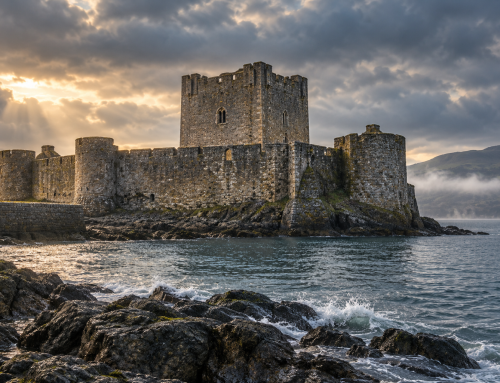
Dunluce Castle stands so close to the Atlantic that the old tale seems entirely believable: one wild night in 1639, the kitchen broke away from the cliff and carried the servants into the sea. It is a fine story. The difficulty is that the kitchen is still there.
🎧 Prefer to listen? Hear the full Ireland: Fact or Folklore episode: Did Dunluce Castle’s Kitchen Really Fall into the Sea?
A story made for Dunluce
Few places invite a legend as readily as Dunluce. The castle sits on a basalt headland on County Antrim’s north coast, joined to the mainland by a bridge and exposed to Atlantic wind, salt and rain. From below, the rock and masonry seem to rise together. From above, the sea appears uncomfortably close.
The familiar version says that, during a storm in 1639, the castle kitchen collapsed into the water. Almost everyone inside was killed, while one fortunate worker survived because they were sitting in the safest corner. Depending on who tells it, that survivor becomes a kitchen boy, a serving girl, a tinker or even a cobbler. The changing identity is the first warning that this is folklore rather than a settled historical account.
What survives?
The strongest objection to the tale is evident in the ruins. The kitchen survives on the eastern side of the inner ward, beside the buttery and close to the north-east tower. Its large fireplace and working arrangement can still be recognised. Whatever was lost from Dunluce, it was not the whole kitchen described in the popular story.
Research into the castle suggests that the missing structure at the northern edge was a high-status range rather than a service kitchen. It had a porch, broad double doors, heated rooms and sea views, and may have included apartments connected with the countess or duchess of Antrim. Building so close to the cliff made dramatic use of the limited space, but it also left the range vulnerable to weathering and collapse.
The verdict: a section of the cliff-edge complex was lost, but the claim that the kitchen and its staff plunged into the sea in 1639 is not supported by the surviving fabric. Early nineteenth-century drawings also show parts of the northern range still standing, which complicates the traditional date.
Why 1639 still matters?
The date may have become attached to a real period of strain at Dunluce. Randal MacDonnell, second Earl of Antrim, and his wife Katherine Villiers had returned to a castle that was impressive but difficult to maintain. A collapse, a structural scare, or the loss of rooms on the exposed northern side could easily have encouraged later stories that the household fled after a single terrifying night.
The castle was not simply abandoned because one kitchen fell. The wider seventeenth century brought rebellion, war, political upheaval and financial pressure. Dunluce’s importance declined over time. The neat tale of one storm ending castle life is memorable, but it compresses a much more complicated history into a single dramatic moment.
Inside the working kitchen?
A great household kitchen was a place of heat, smoke, noise and constant labour. Fires had to be kept, water carried, fuel stored, meat prepared, bread handled, pots scrubbed and food moved to the rooms where the family and guests ate. The buttery beside the kitchen was not a room for making butter; it was associated with storing and issuing drink, especially ale and wine.
The people doing this work rarely dominate the written record. Cooks held skilled positions, but beneath them were assistants and servants carrying out the dirtiest and most repetitive jobs. They worked around open flames, heavy iron vessels, slippery floors and sharp tools. On a crowded headland, every sack of grain, barrel, animal carcass and bundle of firewood also had to cross into the castle or be stored in the outer ward.
We cannot name the supposed victims of the kitchen disaster because there is no reliable list of them. That absence matters. It does not prove that nobody died in a collapse, but it means that confident claims about nine servants, seven servants or one miraculous survivor should not be repeated as fact.
A castle connected to a town
Dunluce was more than a lonely fortress. In the early seventeenth century, Randal MacDonnell established a planned town on the mainland beside it. Archaeology has revealed cobbled streets, stone houses, workshops and evidence of trade and food service. Finds include pottery, glass, coins, animal bone and clay pipes. The castle kitchen therefore belonged to a wider community of craftspeople, merchants, labourers, farmers and servants who supported the MacDonnell household.
This changes the view of daily life. Food did not appear at the fireplace by magic. Cattle and sheep came from the surrounding countryside; fish and shellfish were available along the coast; grain, ale, imported wine and household goods moved through networks of market and sea trade. Dunluce faced the Atlantic, but the water was also a route towards the western Scottish islands and the wider maritime world of the MacDonnells.
Why the legend survived
The tale has everything a visitor remembers: a storm, a cliff, a vanished room, anonymous servants and one impossible escape. It also explains the castle’s broken outline in a single sentence. Folklore often works this way. It attaches a human drama to a visible scar in the landscape.
That does not make the story worthless. It tells us how later generations understood Dunluce — as a place where grandeur was always at the mercy of the sea. The honest version is better than a flat debunking: part of the cliff-edge complex vanished, but the surviving kitchen shows that the best-known account has conflated the building with the casualties and embroidered the casualties.
When you visit
Stand in the inner ward and look for the kitchen remains on the eastern side. Notice the scale of the fireplace, the neighbouring service spaces and how little level ground was available. Then look north towards the missing range. The gap between what survives and what has gone is where the legend took hold.
Dunluce is in State Care and opening arrangements can change. Check the official Department for Communities visitor page before travelling, particularly in poor weather.
Fact, folklore — or both?
Fact: Dunluce lost buildings from its exposed cliff edge, and its ruins record centuries of alteration and decay.
Folklore: the complete kitchen, its servants and a banquet all fell into the sea during one storm in 1639.
The likely truth is less tidy and more interesting. The kitchen survived. A grand northern range was lost. Then memory moved the disaster into the busiest, most human room in the castle and supplied the people that history had forgotten to name.
Listen to the companion episode
Discover the complete story in the Ireland: Fact or Folklore podcast.
Listen to the Dunluce Castle episode
Sources and further reading
Department for Communities, ‘Dunluce Castle’: https://www.communities-ni.gov.uk/heritage-sites/dunluce-castle
Hector McDonnell, A History of Dunluce (revised 2020): https://highcouncilofclandonald.com/wp-content/uploads/2022/11/Dunluce-revised-December-2020.pdf
Colin Breen, Dunluce Castle: History and Archaeology (Four Courts Press, 2012): https://www.fourcourtspress.ie/books/archives/dunluce-castle/
Excavations.ie, Dunluce Castle excavation report, 2009: https://excavations.ie/report/2009/Antrim/0020371/