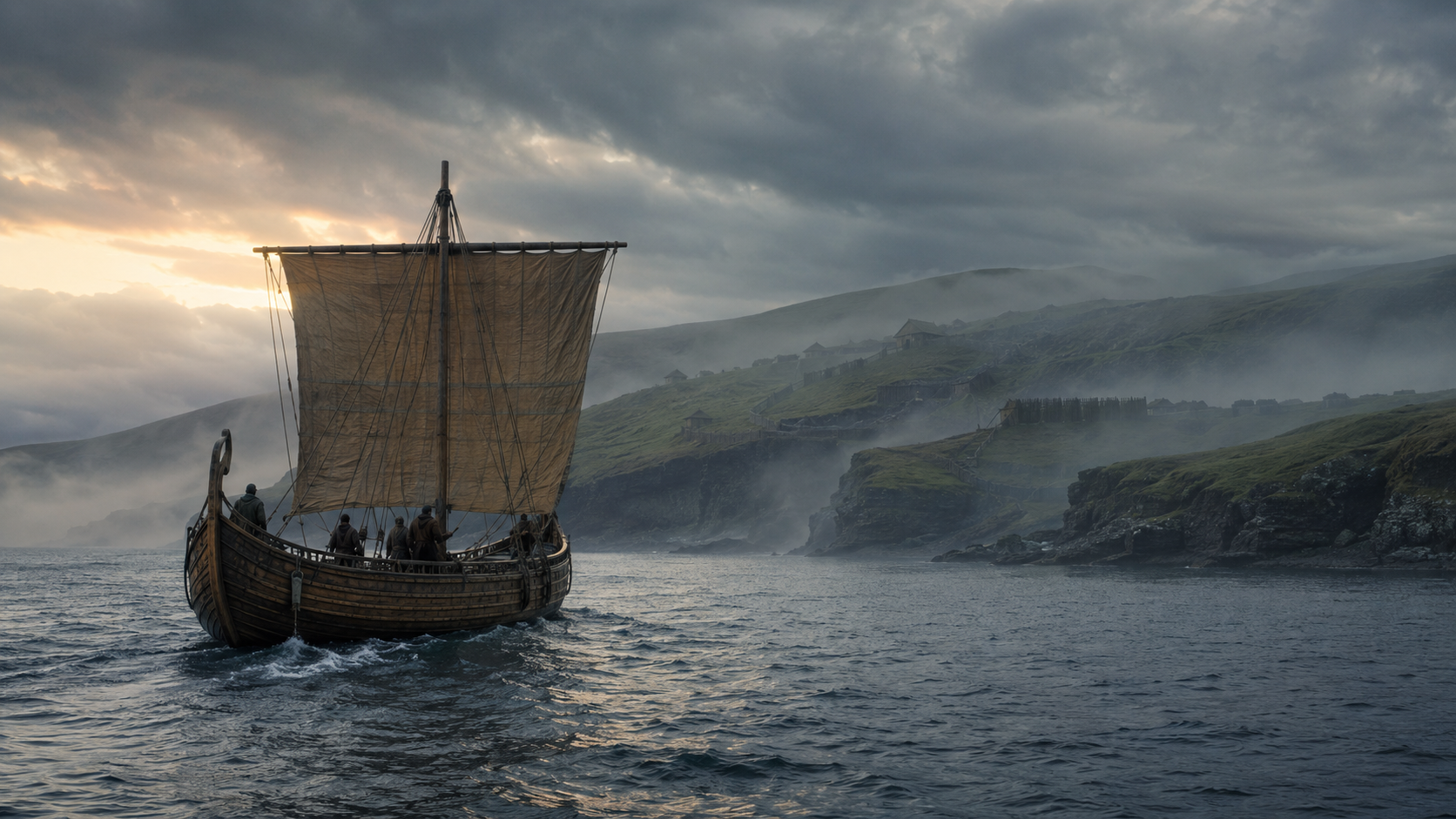
The 2,000-year-old fig, Roman objects and the evidence Rome left behind
Two thousand years ago, someone on a fortified headland in north County Dublin ate a fig.
That sounds wonderfully ordinary until you realise that figs did not naturally grow in Ireland. The charred fruit found at Drumanagh had travelled through a trading world linked to Rome before ending up beside the Irish Sea. Around it were Roman pottery, glass, gaming pieces, combs, animal bone and evidence of spinning and weaving.
So does this finally prove that the Romans invaded Ireland? Not quite. In fact, the archaeology tells a more interesting story: Ireland was never a known Roman province, but neither was it cut off from the Roman world. Goods, people, food, ideas and political ambitions crossed the sea in both directions.
The short answer
| Roman trade and visitors | FACT |
| A brief official or military landing | POSSIBLE, BUT UNPROVEN |
| Roman conquest and occupation | NOT SUPPORTED BY CURRENT EVIDENCE |
| A straight Irish road is automatically Roman | FOLKLORE |
What would a Roman conquest have left behind?
Rome began its conquest of Britain in AD 43. Where Roman rule became established, archaeology usually finds a landscape full of evidence: forts and camps, military roads, planned towns, bathhouses, inscriptions, cemeteries, coins and huge quantities of pottery.
Ireland does not show that pattern. There is no confirmed chain of Roman forts, no legionary base, no planned Roman town, no official milestones and no securely identified Roman military road network. No inscription names a governor of Hibernia, and there is no administrative evidence for an Irish province.
That matters. Conquest is messy. Armies need food, equipment, roads, storage and burial grounds. Administrations produce buildings, money and paperwork. A single imported brooch can travel a long way; an occupied province is far harder to hide.
Ireland was on Rome’s map
Roman writers knew that Ireland existed. They called it Hibernia, and by the second century the geographer Ptolemy was recording Irish rivers, peoples, headlands and settlements. His geography cannot be matched neatly onto a modern map, but it shows that information about Ireland circulated through the wider Roman world.
Tacitus gives us the most tantalising written clue. In his biography of Agricola, governor of Roman Britain, he says that Ireland’s approaches and harbours were known through trade. He also says Agricola had received an exiled Irish ruler and believed Ireland could be conquered with a single legion and supporting troops.
That is intriguing, but it is not a record of an invasion. Tacitus was praising his father-in-law, and he never says Agricola crossed to Ireland. A plan, an ambition or a boast is not the same thing as a landing.
Drumanagh: the site that changed the conversation
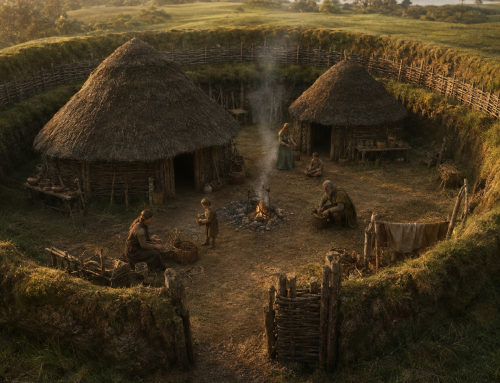
Drumanagh is a large promontory fort near Loughshinny in north County Dublin, defended by three banks and ditches and looking directly towards Roman Britain. For decades it attracted dramatic labels: Roman fort, trading colony, invasion bridgehead.
Scientific excavation began in 2018, and the results have been more human — and more useful — than the old invasion headlines. Fingal County Council’s Digging Drumanagh project has uncovered Iron Age structures, craft activity, animal bone, shell, glass, beads, dice, combs and imported pottery from the Roman world.
In 2019, archaeologists recovered almost eighty fragments of Dressel 20 amphorae. These large containers were made in Baetica, in southern Spain, and were widely used to transport olive oil around the Roman Empire.
The important point is not simply that Roman objects reached Ireland. At Drumanagh, imported goods sit beside evidence of local work and ordinary life. People were spinning, weaving, eating, playing games and using an important coastal place. This looks like a community connected to the Roman world, not an empty beach waiting for an army.
The fig that travelled farther than most people
During post-excavation analysis in 2024, a shrivelled object first thought to be an apple was identified as a charred fig dating to around two thousand years ago. Fingal County Council describes it as without parallel in Ireland and the oldest exotic fruit yet found here.
The fig is small, but its implications are large. Metal, pottery and glass can survive long journeys. Food is different. A dried fig had to move through a functioning chain of exchange before someone finally ate it on the Dublin coast.
It still cannot tell us who carried it. The traveller may have been a merchant from Roman Britain, an Irish person returning home, or one of several people who passed the food from port to port. What it proves is connection, not conquest.
And then came the intact pot
The 2025 season produced another headline: an intact Roman pot, described at the time as the first intact example excavated in Ireland. It was sent for conservation and specialist analysis. That is exciting, but it is worth keeping the archaeological brakes on. One object, however striking, cannot by itself turn Drumanagh into a Roman garrison.
The wider pattern remains the important part: repeated contact with Britain and continental Europe, alongside local activity and local lives.
Lambay Island: objects, burials and uncertain identities
Just offshore, Lambay Island adds people to the story. Burials disturbed near the harbour in 1927 produced an unusual collection of late Iron Age and Roman-world objects, including brooches, rings, metal fittings and weapons-related pieces. Some have close parallels in Roman Britain.
It is tempting to call the people in those graves Roman soldiers, but archaeology cannot support that certainty. They may have been people from Britain, Irish travellers who returned home, mercenaries, refugees, members of mixed families or individuals whose possessions connected them to more than one culture.
That uncertainty is not a weakness. It is a reminder that the Irish Sea was not a hard cultural border. People crossed it for trade, work, politics, marriage, danger and opportunity.
Lambay is a private island. Current visits are through official arranged tours and day trips, with seasonal restrictions, so check the island’s own visitor information before making plans.
Roman coins at Newgrange
Roman coins and gold objects have also been found around Newgrange. By the Roman period, the great passage tomb was already more than three thousand years old.
The concentration of Roman-period valuables around such an ancient monument has often been interpreted as ritual or votive deposition. That is more convincing than imagining generations of legionaries repeatedly losing money beside the same prehistoric tomb.
The finds still do not identify the people who placed them. Irish communities could have acquired Roman valuables through trade, travel, gift exchange or service abroad and then offered them at a place that still carried extraordinary meaning.
An empire’s objects can cross a frontier much more easily than its government.
Could a small Roman expedition have landed?
This is where the answer becomes ‘possible, but unproven’. Roman officials operated beyond formal frontiers. They gathered intelligence, supported useful rulers and sometimes sent small forces into places they did not intend to annex.
Agricola’s unnamed Irish exile gives us a believable political opportunity. A diplomatic escort, scouting party or small armed group could have crossed the Irish Sea and left only limited traces.
But a theory should not become stronger every time evidence is missing. A full conquest would require repeated supply, movement and control. We should expect camps, military material, roads, forts or destruction layers that connect into a coherent system. That pattern has not been found.
What about those suspiciously straight Irish roads?
A straight road is one of the quickest ways to start a Roman-road argument. In Britain, straightness can be a useful clue because it sits inside a landscape already full of Roman forts, towns and military routes.
In Ireland, straightness alone proves very little. Roads can be direct for many reasons: estate planning, military engineering in a later period, access to quarries or mills, market routes, harbour connections or simple surveying convenience.
Archaeologists look beneath the surface for construction layers, drainage, width, associated structures and datable material. Without that evidence — and without a Roman network to connect the road to — ‘it is straight, therefore Roman’ belongs firmly in the folklore column.
What the evidence actually tells us
The most useful question may not be ‘Why did Rome fail to conquer Ireland?’ but ‘What happened because Ireland sat beside the Roman world without becoming part of it?’
The archaeology shows people on the east coast handling imported pottery and glass, eating food that had travelled enormous distances, using foreign styles and crossing the sea. It shows Roman interest in Irish harbours and politics. It also shows Irish communities remaining outside direct imperial administration.
That makes the story less like a missing chapter of Roman conquest and more like a borderland story: two shores connected by trade, migration, diplomacy and curiosity.
The old schoolbook line that ‘the Romans never came to Ireland’ is too simple. The dramatic claim that Rome secretly conquered Ireland asks far more of the evidence than it can currently support.
The truth sits between them — and, as so often happens in archaeology, it is the ordinary details that make it memorable: a comb, a die, a pot of olive oil and one very well-travelled fig.
If you want to explore the story
The north County Dublin coast is the best landscape in which to picture the connection. From the Fingal shoreline, Roman Britain was across the same sea that merchants, travellers and perhaps officials crossed two thousand years ago.
For Drumanagh, use Fingal County Council’s heritage information and respect current access arrangements around archaeological land. Lambay is privately owned and can only be visited through arranged tours. Newgrange, within Brú na Bóinne, is a managed heritage attraction with its own visitor arrangements.
Even if you never set foot on any of the sites, look at the map. Drumanagh, Lambay and the Boyne Valley form part of an east-coast zone where contact with Britain makes geographical sense. The Irish Sea was not the edge of the world. It was a route.
Listen to the full episode
This article accompanies the Ireland: Fact or Folklore episode, Did Rome Secretly Invade Ireland? The Evidence Rome Left Behind.
In the episode, we follow the fig, the Lambay burials, Tacitus, Newgrange and the supposed Roman roads before giving each claim a verdict: fact, possible but unproven, or folklore.
Podcast link: Spotify Youtube to follow
Sources and further reading
- Fingal County Council — Digging Drumanagh — Excavation seasons, Drumanagh finds, Dressel 20 amphorae, the fig and 2025 results.
- The Discovery Programme — Late Iron Age and ‘Roman’ Ireland — Major research project covering Roman material in Ireland, Drumanagh and Lambay.
- Tacitus, Agricola, chapter 24 — Perseus Digital Library — Ancient written source for Agricola, Irish trade, harbours and the exiled ruler.
- Brú na Bóinne World Heritage Site Research Framework — Discussion of Roman coins and gold objects from Newgrange and their possible votive context.
- RTÉ News — ‘First ever’ intact Roman pot found in Ireland — Contemporary report on the 2025 Drumanagh pot discovery and the caution around interpretation.
- Lambay Island — official visitor information — Current information on arranged tours, boat transfers and seasonal access.