
Today, defibrillators sit in airports, shopping centres, sports grounds, workplaces and village halls. We are used to seeing the familiar AED sign and a brightly coloured box waiting on a wall.
But the idea that lifesaving cardiac equipment should travel to the patient rather than wait for the patient to reach hospital helped transform emergency medicine — and a crucial part of that story began in Belfast.
The problem was happening before patients reached hospital
During the 1960s, cardiologist Professor Frank Pantridge was working at Belfast’s Royal Victoria Hospital alongside doctors including John Geddes.
Hospital coronary care was improving, but there was an obvious problem. Many people suffering a heart attack became critically ill during the first hours after their symptoms began. Some died before they ever reached a coronary care unit.
The Belfast team began asking a deceptively simple question:
What if intensive cardiac care could leave the hospital and go to the patient?
That question would change emergency medicine.
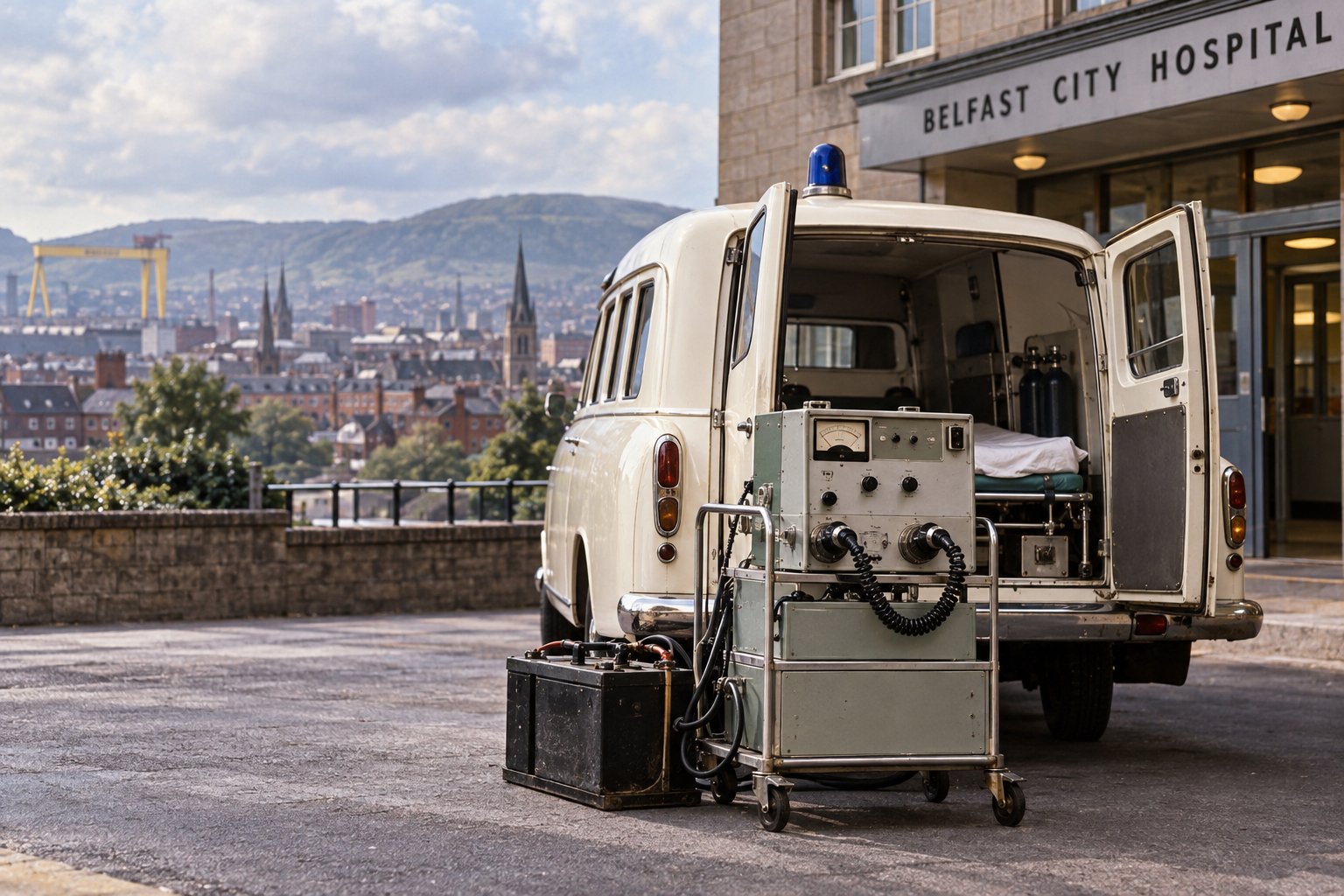
Belfast’s cardiac ambulance
Pantridge, Geddes and their colleagues developed a mobile coronary care service using an ambulance equipped to treat serious cardiac emergencies.
The first system was hardly something you could tuck under your arm. Its defibrillator was powered by car batteries and weighed about 70 kg (154 lb).
Nevertheless, it could travel.
On 1 January 1966, Belfast’s mobile coronary care unit began operating, bringing trained medical staff and cardiac equipment directly to patients.
When Pantridge and Geddes published their results in The Lancet in 1967, they reported 312 calls during the scheme and ten successful resuscitations outside hospital. Five of those patients were still alive when the results were reported.
The importance was enormous: cardiac arrest outside hospital did not automatically have to mean there was nothing more that could be done.
From 70 kg to something truly portable
The Belfast team continued developing the equipment.
By 1968, Pantridge had helped produce a much smaller, self-contained defibrillator — roughly the weight of a newborn baby.
That mattered because a machine that required several people to move it would always have limits. A genuinely portable device could eventually travel in ambulances, aircraft and emergency vehicles and, with later technological developments, find its way into public places.
Pantridge also envisaged the idea of automatic defibrillation. In time, automatic external defibrillators — AEDs — would allow suitably designed equipment to guide non-specialists through an emergency.
One invention — or a team effort?
You will often see Frank Pantridge described simply as “the inventor of the portable defibrillator.”
That description is widely used, including by Queen’s University Belfast and the Royal College of Physicians, but the fuller history is worth remembering.
Pantridge led the work and became its best-known advocate, while John Geddes played an important role in recognising the potential of pre-hospital defibrillation and establishing Belfast’s mobile coronary care system. Technicians, doctors, nurses, ambulance staff and engineers also helped turn the idea into something that could work outside the hospital.
It is a good example of how inventions often happen in real life: not as a single flash of inspiration, but through a problem, a team and repeated attempts to make something better.
From Belfast to the world
The Belfast approach attracted considerable international interest. Similar mobile coronary care systems were adopted elsewhere, particularly in North America.
The basic idea behind the Pantridge system seems almost ordinary today: reach the patient quickly, treat a dangerous heart rhythm immediately and begin specialist care before arriving at hospital.
At the time, it was anything but ordinary.
A machine that once weighed about 70 kg can now be found in compact public-access cabinets around the world.
And behind that familiar modern device is a remarkable chapter of Irish medical history that began with a group of people in Belfast asking why lifesaving treatment had to remain inside a hospital.
Fact or Folklore?
Fact: Professor Frank Pantridge and the Belfast cardiac team were pioneers of portable defibrillation and pre-hospital coronary care.
But the fuller story is better than the shorthand version. This was not simply one man inventing a box. It was a Belfast medical team changing where emergency medicine could happen.
The next time you pass a public defibrillator, it is worth remembering that part of its story leads back to Northern Ireland.
Listen to the full Ireland: Fact or Folklore episode for the story of Frank Pantridge, Belfast’s first mobile coronary care unit and the invention that helped change emergency medicine.
Sources and further reading
Pantridge, J. F. & Geddes, J. S. (1967), “A Mobile Intensive-Care Unit in the Management of Myocardial Infarction”, The Lancet, 2(7510), pp. 271–273. DOI: 10.1016/S0140-6736(67)90110-9.
Royal College of Physicians Museum, James Francis Pantridge (1916–2004).
Royal College of Physicians Museum, John Stafford Geddes.
The BMJ (2005), Frank Pantridge, obituary and biographical account.
Queen’s University Belfast, School of Medicine, Professor Frank Pantridge – Inventor of the Portable Defibrillator.
National Museums NI, Museum of Innovation, including the story of Pantridge and Belfast’s pioneering cardiac ambulance.