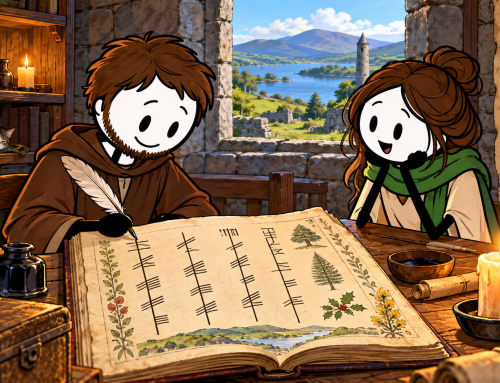
Podcast will be available on Spotify and YouTube sometime in the future. Perhaps even this month. Look beyond the famous pages of the Book of Kells and discover the calfskin, poisonous pigments, hidden animals and clues to where it was really made.
The Book of Kells is so famous that it is easy to stop actually looking at it.
We recognise the intricate patterns. We know it is kept at Trinity College Dublin. We associate it with medieval Ireland, monks and extraordinary craftsmanship.
But forget the famous full-page images for a moment.
Zoom in.
The smaller details tell a rather different story.
They reveal animals hidden inside letters, tiny construction marks, imperfect calfskin, hazardous pigments and even mistakes made by the people copying the text.
And together, those clues leave us with one particularly awkward question.
Was the Book of Kells actually made in Ireland?
Before the artwork came the cows
The Book of Kells contains the four Christian Gospels in Latin and survives today as 340 folios, or 680 pages. Its pages measure roughly 33 cm by 25.5 cm (13 by 10 in), although they were trimmed during later rebinding.
But those pages are not paper.
They are vellum – prepared calfskin.
Recent research discussed by Trinity College Dublin estimates that around 159 calfskins were needed for the surviving manuscript.
That is worth thinking about.
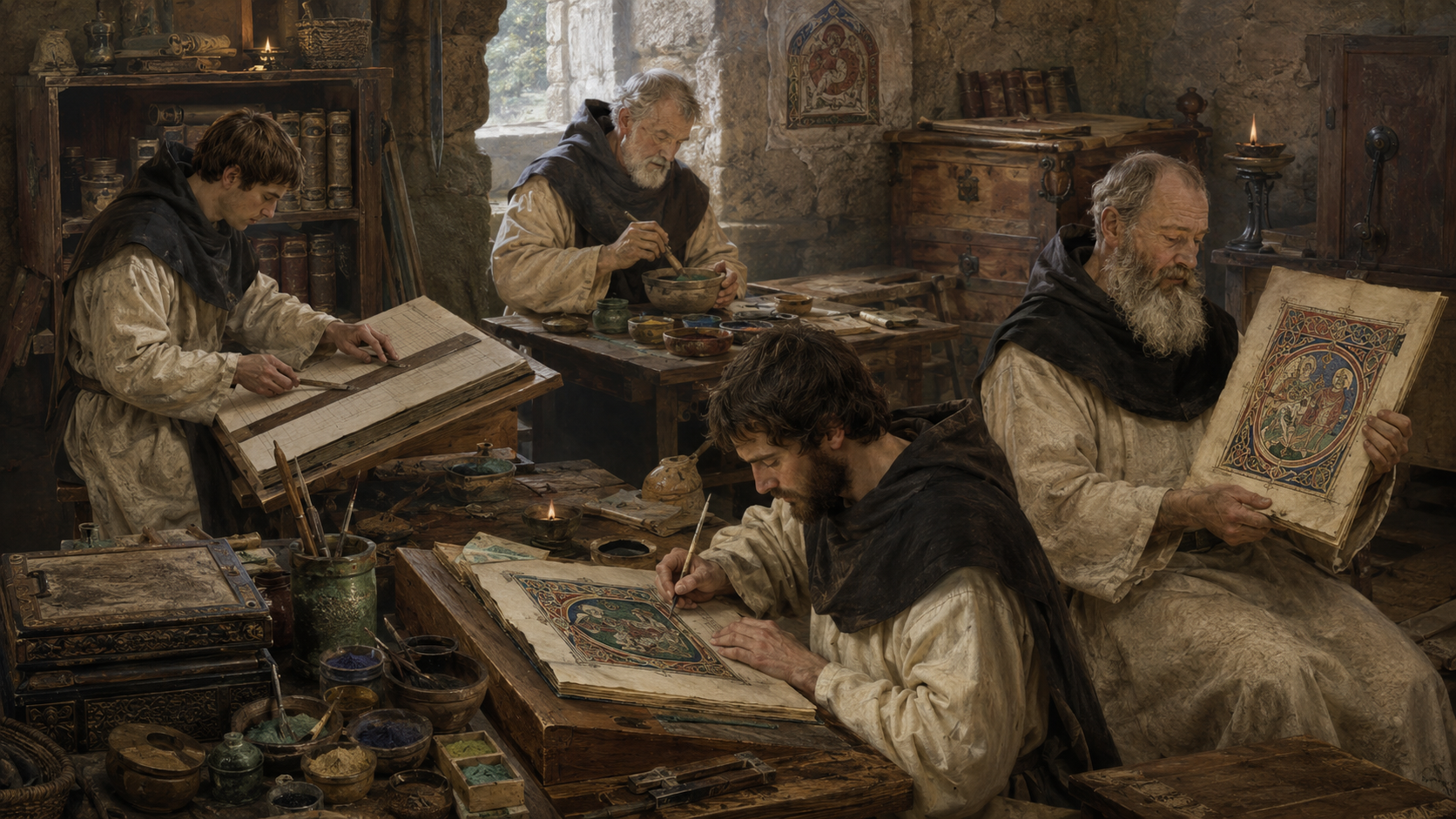
Before a scribe wrote a word, somebody had to rear the cattle. The hides then had to be cleaned, stretched, scraped and prepared carefully enough to create a surface suitable for writing and painting.
Some pages are better quality than others.
Suddenly the Book of Kells is not simply the work of a few mysterious monks.
Behind it stand farmers, livestock, craftspeople, supplies and an entire community capable of supporting a project that must have consumed an enormous amount of time.
The brilliant yellow came with a warning
The colours are another surprise.
For years, an appealing story suggested that the manuscript’s blue pigment came from expensive lapis lazuli brought from distant Asia.
Scientific analysis has instead found that the blue was made using indigo or possibly woad.
The spectacular yellow included orpiment – arsenic sulphide.
Red included toxic red lead. Copper compounds were used in green pigments, while gypsum provided white. Researchers have even found that copper green has damaged some of the vellum over the centuries.
So the medieval workshop was probably less romantic than we imagine.
There were skins being scraped, pigments being ground and substances being mixed. Some of those substances could stain, corrode or poison.
The artists did not have modern chemistry books.
But they clearly understood materials extremely well.
Their palette came partly from geology and partly from the living landscape around them.
There are creatures everywhere
Look closely at the Book of Kells and the pages begin to move.
Birds appear among the decoration.
Snakes coil through designs.
There are lions, hares and peacocks. Human figures twist around letters and tiny faces appear where you might never notice them at normal size.
Some creatures carried Christian symbolism. Others were inherited through artistic traditions stretching far beyond Ireland.
But the familiar animals also remind us that the people who made the manuscript lived much closer to the natural world than most of us do today.
Cattle were not an illustration in a book. They were wealth, food and raw material.
Birds surrounded settlements.
Plants provided food, medicine, fibre and colour.
And then the artists transformed that ordinary world into something extraordinary.
If you explore the digitised Book of Kells online, try something different.
Do not immediately search for the most famous page.
Pick a page and zoom in until you find an animal.
It can feel remarkably like discovering something the artist left there specifically for you.
The perfect manuscript contains mistakes
Here is another part of the story that tends not to appear on souvenir mugs.
The Book of Kells contains copying errors.
Letters and words were omitted. Text was repeated. On one occasion, duplicated writing was marked out with red crosses.
That apparent contradiction may tell us something important.
This might not have been an everyday book intended primarily for careful reading.
It may have been a ceremonial object brought out on important occasions.
Imagine seeing it around the year 800.
Many people witnessing it would not have understood Latin. Some would not have been able to read at all.
But everybody could understand spectacle.
Colour. Scale. Complexity. Gold-like yellows. Animals twisting into letters.
A book unlike anything encountered in ordinary life.
The page itself could communicate importance before anybody read a word.
And then there is the problem of Kells
Despite its name, nobody has proved that the Book of Kells was actually made at Kells in County Meath.
The manuscript probably dates from around the late eighth or beginning of the ninth century.
Kells became an important Columban monastery after monks associated with Iona, off the west coast of Scotland, sought greater safety following Viking attacks.
For a long time, one of the strongest theories has therefore been that the manuscript was begun at Iona and perhaps continued or completed at Kells.
But even that is not certain.
In 2025, Trinity College highlighted renewed arguments for connections with Pictish Scotland. Archaeological excavations at Portmahomack in north-east Scotland revealed evidence for large-scale parchment manufacture, while similarities have also been proposed between Pictish carved stones and imagery within the manuscript.
That does not mean the Book of Kells has suddenly been proven to be Pictish.
It has not.
The evidence has simply made an old mystery more interesting.
Perhaps the mistake is trying too hard to give the manuscript a modern nationality.
The religious communities of early medieval Ireland and Britain communicated and travelled across the Irish Sea. Books, artistic ideas, craftspeople and religious traditions moved with them.
The sea separating Ireland and Scotland could also be the thing connecting them.
Somebody once stole it
By the early eleventh century, the manuscript was definitely associated with Kells.
Then somebody stole it.
Historical records describe the great Gospel book being taken for its valuable ornamental covering or shrine.
The manuscript itself was eventually recovered.
The precious covering was not.
There is something wonderfully human about this part of the story.
Today we think the painted pages are priceless.
The medieval thief appears to have been rather more interested in the removable valuables around them.
The masterpiece survived an encounter with somebody who seemingly did not regard the bit we treasure most as the most valuable part.
Perhaps survival is the real masterpiece
The Book of Kells is usually presented as a triumph of medieval art.
It is.
But I think there is another way of looking at it.
Its makers are anonymous.
Its birthplace is uncertain.
Its original cover disappeared.
Pages have been damaged.
The manuscript contains mistakes.
Its edges were later trimmed.
It has been stolen, rebound, moved and examined.
Yet more than twelve centuries after somebody first lowered a pen onto calfskin, we can still see the marks that person made.
That is extraordinary.
Not because the Book of Kells somehow escaped history.
But because it survived history.
And behind that survival is a chain of people: farmers, craftspeople, scribes, artists, monks, librarians, conservators and countless others whose names have disappeared.
Perhaps that is the part worth remembering when you look through the glass at Trinity College.
You are not simply looking at an old book.
You are looking at twelve centuries of people deciding, deliberately or accidentally, not to let it disappear.
Fact or Folklore?
Was the Book of Kells made in Ireland?
We cannot yet say for certain.
Iona remains central to the established debate, Kells may have played a part in its creation, and intriguing evidence has reopened questions about connections with the Pictish world.
And somehow, not knowing makes the manuscript more interesting rather than less.
Want the full story?
Listen to the companion Ireland: Fact or Folklore episode, ‘The Book of Kells: Ireland’s Masterpiece – Or Scotland’s?’, where we investigate its mysterious origins, Viking-era upheaval, extraordinary artwork and the theft that nearly changed its story forever.
What do you think: Iona, Kells, both – or somewhere else entirely?
Suggested tags
Book of Kells, Ireland history, Irish history, Irish archaeology, Trinity College Dublin, Kells County Meath, Iona, medieval Ireland, illuminated manuscripts, Irish monasteries, Celtic art, Ireland Fact or Folklore
Research sources
Trinity College Dublin – Book of Kells: https://www.tcd.ie/library/research-collections/book-of-kells.php
Trinity College Dublin – Book of Kells information: https://www.tcd.ie/about/content/bookofkells_index.php
Trinity College Dublin (2025) – Book of Kells: exploring the evidence that points to Pictish origins: https://www.tcd.ie/news_events/articles/2025/book-of-kells-exploring-the-evidence-that-points-to-pictish-origins-/
Originality note: This companion article is newly written in original language and is intended to complement, rather than reproduce, the podcast episode.