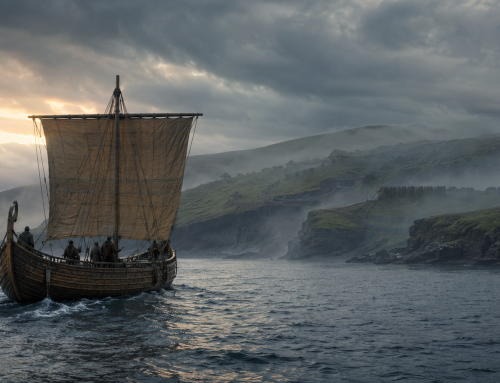
A longship cuts through the mist. Armed men reach the shore. A monastery burns. It is the familiar picture of the Viking Age—and it is based on real violence. Yet it captures only one part of a story that unfolded in Ireland over several centuries.
THE VERDICT: Vikings were raiders, but they were never just raiders. They also became settlers, traders, craftspeople, farmers, political allies and members of mixed Hiberno-Norse communities.
A word that needs care
Today, Viking is often used for almost anyone from Scandinavia during the Viking Age, roughly the late eighth to the eleventh century. Historically, the word was more closely associated with taking part in a seaborne expedition, particularly one involving raiding. Not every Scandinavian farmer, craftworker, woman, child or older person was a Viking in that occupational sense.
There was no single Viking nation or master plan. Leaders, families, crews and trading communities competed with one another. They fought Irish rulers and other Scandinavian groups. At other times they made agreements with Irish kings, joined their armies and married into Irish society.
Why Ireland was raided
Ireland’s monasteries were religious centres, but many were also centres of learning, craftwork, landholding and political influence. They could hold valuable metalwork, livestock, food stores and people who might be ransomed or enslaved. Coastal and island sites were accessible by sea and vulnerable to fast attacks.
Irish annals record seaborne attacks at the end of the eighth century. The precise identification and modern date of the first Irish target are not entirely straightforward because the surviving chronicles were compiled and copied over time. What is secure is that attacks on religious communities in Ireland and western Britain had begun by this period.
Longships helped make those attacks possible. Their shallow draught allowed crews to cross open water, approach beaches and move along rivers without needing a large harbour. At first, many expeditions were seasonal: strike quickly, seize portable wealth and leave before local forces could gather.
Bangor: when the raiders came to County Down
Bangor’s monastery was founded by Comgall in the sixth century. It became an important religious and scholarly centre with connections far beyond Ireland. Its position at Bangor Bay, looking towards Belfast Lough and the North Channel, connected it to wider seaways—but also exposed it to attack.
The Annals of Ulster use the name Bennchor for Bangor and record a heathen invasion in an entry associated with 823. A further entry says the attackers plundered Bangor, destroyed its oratory and disturbed the relics of Comgall in their shrine. The Annals of Inisfallen add that learned men and bishops were killed.
These short entries do not reveal the number of ships, the duration of the attack, or a reliable total of the dead. The often-repeated claim that 900 monks were killed is not supported by the checked annal entries and should not be treated as established fact.
Bangor’s story is not solely one of defeat. The monastery survived, and the wider region resisted. Later annal entries record the Ulaid defeating a Viking force in Mag Inis in County Down. Viking armies could cause devastation, but Ireland was not simply defenceless.
Visitor note: North Down Museum at Bangor Castle includes displays about Bangor’s early monastery and the Viking attacks. Check current opening times and gallery availability before travelling.
From seasonal raids to permanent bases
By the 830s, larger fleets were operating, and some forces began remaining through the winter. In 841, the annals record longphorts—fortified ship-camps—at Dublin and Linn Duachaill. These protected ships, warriors, supplies and captives while providing bases for inland expeditions.
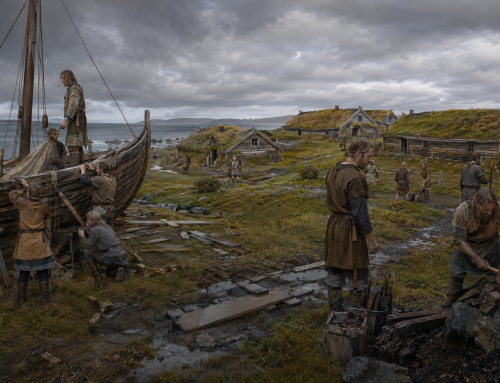
Some camps disappeared. Others developed into permanent settlements. Once people stayed, they needed houses, food, timber, workshops, repairs and relationships with the surrounding countryside. A raiding base could become a market, a political centre and eventually a town.
What archaeology reveals
Excavations around Wood Quay in Dublin uncovered timber houses, pathways and workshops, along with thousands of objects preserved in damp ground. Wooden bowls, leather shoes, combs, spindle whorls, needles, gaming pieces, tools, locks and keys show ordinary domestic and working life.
Weapons occur in graves, but so do weighing scales and craft tools. Brooches and textile equipment help reveal women within the settlements, while small shoes and domestic spaces remind us that children grew up there. This was not an exclusively male army living permanently on stolen treasure.
Objects must still be interpreted carefully. A sword does not prove that its owner raided every day; scales do not prove that a merchant never fought. The same person might farm at home, trade in one port and raid another coast.
Trade—and the people treated as goods
Viking networks linked Ireland with Britain, the North Atlantic and routes reaching continental Europe, the Byzantine world and the Islamic world. Silver, amber, glass and fine metals travelled great distances. In Ireland, silver was often valued by weight, which helps explain finds of scales, weights, cut silver and arm-rings.
Dublin became a major Irish Sea port. Trade required cooperation, trusted contacts, storage and customers; a market cannot operate through robbery alone. Irish rulers and producers could gain access to imported goods and silver, while Scandinavian settlements depended upon food and raw materials from outside the towns.
The harsh qualification is slavery. Human beings were among the most profitable commodities. Slavery and captive-taking existed in Ireland before the Scandinavians arrived, but Viking networks expanded their scale and geographical reach. Irish captives were exported, and captives from Britain and elsewhere were brought into Ireland. Exact totals do not survive.
Ireland’s first coins—but not its first trade
Around 997, Dublin began producing Ireland’s first coins under the Hiberno-Norse king Sitric Silkbeard. The earliest issues copied English designs. Coin production indicates royal authority, skilled manufacture and an economy increasingly centred on towns and international exchange.
That does not mean Ireland lacked trade before the Vikings. Irish communities had longstanding contacts with Britain and continental Europe, and monasteries were economically active. The better-supported claim is that Scandinavian maritime networks expanded and reorganised trade, thereby making permanent coastal towns more important.
Did the Vikings found Ireland’s first towns?
Dublin, Waterford, Limerick, Cork and Wexford developed from Viking bases into Ireland’s first recognisable towns during the tenth century. Ireland already possessed royal centres, monasteries and markets; it was not an empty rural land waiting to be civilised. The change was the growth of permanent coastal settlements with concentrated crafts and long-distance commerce on a new scale.
Waterford and Wexford retain names derived from Old Norse fjord names, although neat popular translations are sometimes more confident than the linguistic evidence allows. Dublin existed as an Irish place before Scandinavian settlement, but the Norse town transformed its scale and international role.
Enemies, allies and neighbours
The political story was never simply Ireland on one side and Vikings on the other. Early medieval Ireland contained competing kingdoms, and Norse-controlled towns entered those struggles. Their rulers made alliances with Irish kings, fought for territory, paid or demanded tribute and changed sides when power required it.
The Battle of Clontarf in 1014 is often presented as the Irish expelling the Vikings. The reality was more complicated. Brian Boru’s forces faced an alliance involving the king of Leinster, Hiberno-Norse Dublin and warriors from across the Norse world, but Irish and Scandinavian identities did not form two perfectly separate teams. Brian’s side won and he was killed; Dublin survived and remained commercially important.
By the late tenth and eleventh centuries, many Scandinavian communities had adopted Christianity. Intermarriage, fosterage, conversion and political alliance produced a mixed Hiberno-Norse culture. For families born in the ports, Ireland was home.
Fact or folklore?
FACT: Viking raids brought killing, destruction, plunder and enslavement to Irish communities.
FACT: Scandinavian settlers built homes and workshops, traded, farmed, fished, minted coins, reshaped ports and became involved in Irish politics.
FOLKLORE: All Vikings wore horned helmets. No convincing Viking-Age evidence supports the familiar horned-warrior image.
MISLEADING: Vikings were peaceful traders unfairly portrayed by monks. This correction ignores warfare, captivity and the slave trade.
MISLEADING: Vikings created trade, slavery or civilisation in an otherwise undeveloped Ireland. All existed in some form before their arrival; Scandinavian activity expanded and reorganised them.
FINAL VERDICT: The horned helmet is a myth, but the sword was not. The mistake is allowing the sword to obscure the market, farm, workshop, shipyard and family home. Vikings were raiders, but they were never just raiders.
Listen to the podcast
Hear the full Ireland: Fact or Folklore episode, Were Vikings Just Raiders?, for the story of the Bangor attacks, Viking Dublin, Clontarf and the evidence behind the verdict.
Pronunciation guide
Comgall — COM-gall
Bennchor — BEN-khor (approximate)
Annals of Inisfallen — in-ish-FAL-en
Ulaid — OO-lid
Mag Inis — mag IN-ish
longphort — LONG-fort
Linn Duachaill — lin DOO-uh-khill
Hiberno-Norse — hy-BER-no NORS
Sitric Silkbeard — SIT-rik
Clontarf — clon-TARF
Brian Boru — BREE-an BOR-oo
Sources and further reading
- National Museum of Ireland, ‘The Viking Age in Ireland’ — museum.ie
- The Annals of Ulster, edited and translated by Seán Mac Airt and Gearóid Mac Niocaill, CELT, University College Cork — celt.ucc.ie/published/T100001A.html
- The Annals of Inisfallen, edited and translated by Seán Mac Airt, CELT, University College Cork — celt.ucc.ie/published/T100004.html
- Ards and North Down Borough Council, Bangor heritage information — ardsandnorthdown.gov.uk
- Patrick F. Wallace, Viking Dublin: The Wood Quay Excavations, Irish Academic Press, 2016.
- Stephen H. Harrison and Raghnall Ó Floinn, Viking Graves and Grave-Goods in Ireland, National Museum of Ireland, 2014.
- Clare Downham, Viking Kings of Britain and Ireland, Dunedin Academic Press, 2007.
- Alex Woolf, ‘The Scandinavian Intervention’, The Cambridge History of Ireland, volume I, 2018.