COSY IN IRELAND | PODCAST COMPANION
Fairy Forts in Ireland
Were they built for the Good People?
Companion article for Ireland: Fact or Folklore
SHORT ANSWER: FOLKLORE — WITH A REAL HISTORICAL EFFECT. Most “fairy forts” are the remains of human settlements, mainly from the early medieval period. Later stories placed the fairy folk within these abandoned enclosures. Those beliefs were genuinely recorded and sometimes helped protect the archaeology, but they do not prove supernatural occupation or an unchanged pre-Christian tradition.
Two histories in one field
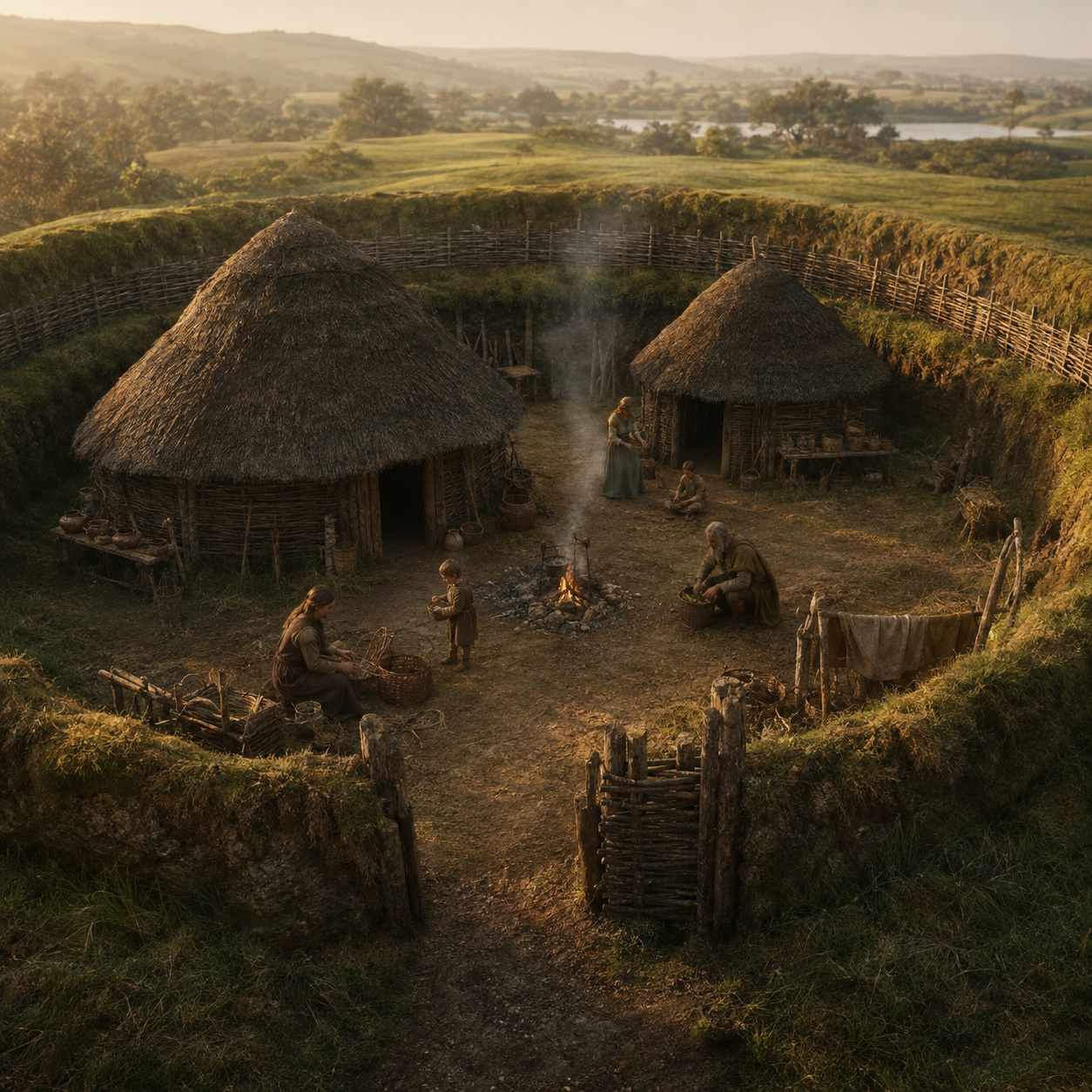
Across Ireland, circular banks and stone walls interrupt fields, lanes and hedgerows. To an archaeologist, many are ringforts: enclosed farmsteads where people lived, worked, stored food and protected livestock. In folklore, the same places became fairy forts, guarded by the Good People, the Gentry or the Other Crowd.
The two explanations should not be forced into a false choice. Archaeology tells us what the monuments were built for. Folklore records what later communities believed about them. Both belong to the history of the landscape, but they are different kinds of evidence.
What is a fairy fort?
Most fairy forts are ringforts: circular or oval enclosed settlements used mainly between about the sixth and tenth centuries, although individual sites may be earlier or later. The surviving bank, ditch or stone wall once surrounded timber, wattle-and-daub or thatched buildings that have largely disappeared.
An earthen ringfort may be called a ráth or lios. A stone-built enclosure may be called a cashel or cathair. Some contained souterrains—underground stone-lined chambers or passages probably used for storage, refuge or both.
Ringforts were not all alike. Many were ordinary family farms. Larger sites with several banks and ditches could display wealth and political standing. Estimates commonly suggest tens of thousands were built or survive across Ireland, but exact totals vary because records and definitions differ. Not every circular earthwork is a ringfort.
The fairy folk were not tiny winged figures
The beings in older Irish tradition were often imagined as human-sized and unpredictable. They might appear beautiful, ordinary or frightening. Stories gave them families, animals, music, processions and rivalries. Courtesy could be rewarded; intrusion could be punished.
People often avoided naming them directly. “The Good People”, “the Gentry”, “the Other Crowd” and “Themselves” were safer terms. Aos Sí means approximately “people of the mounds”. The sí was an Otherworld mound or dwelling—but an early literary mound should not automatically be treated as the same thing as every later farm ringfort.
Stories warned against cutting a lone hawthorn, moving stones, blocking a fairy path or disturbing a fort. Reported consequences included sick cattle, spoiled milk, machinery failure, disorientation and bad luck. These accounts are evidence that people told and sometimes acted upon the beliefs. They are not evidence that fairies caused the events.
How did a farmstead become a fairy residence?
No surviving source gives a precise date when ordinary ringforts became widely understood as fairy homes. Once settlements were abandoned, their houses decayed while their banks remained. Their builders could be forgotten, underground chambers became mysterious, and local storytelling supplied new occupants.
Medieval Irish literature certainly connected supernatural beings with Otherworld mounds. Works such as Tochmarc Étaíne and Lebor Gabála Érenn helped shape later ideas about hidden peoples and entrances to another world. Christianity did not simply remove those ideas; it mixed with and reinterpreted them. Fairies might be described as fallen angels, ancient inhabitants, the pagan dead or a separate race.
The attractive claim that fairy-fort belief is an untouched survival from pre-Christian religion goes beyond the evidence. Most ringforts were built after Christianity was established in Ireland, and the folklore recorded much later contains several historical layers.
What the Schools’ Collection records
Between 1937 and 1939, pupils across the Irish Free State gathered folklore from parents, grandparents and neighbours for the Schools’ Collection. Dúchas.ie now makes the material searchable, including thousands of records connected with fairy forts.
The accounts describe lights, music, dancing, underground passages, fairy routes and warnings against cutting trees or disturbing soil. They also show that there was no single national rulebook. In one district, no branch could be cut. Elsewhere, timber might be taken provided the soil was not disturbed. A family might leave a window or doorway clear because a house stood on a fairy pass.
This variation matters. Folklore was local, negotiated and repeatedly retold. The archive proves the strength and reach of the tradition; it cannot prove the supernatural explanation offered within a story.
Rathgurreen: new archaeology beneath an old fort
Excavations at Rathgurreen on the Maree Peninsula in County Galway show how complicated a ringfort’s human history can be. University of Galway research announced in 2025 described a large, high-status settlement with two banks and ditches, about 95 metres (312 feet) across externally.
Evidence suggests several phases of activity. Finds and earlier discoveries include metalworking evidence, amber beads, imported pottery, shellfish used in purple-dye production and a late Roman oil lamp. The site had connections extending beyond the local district, and parts may be around 1,000 years older than its familiar early-medieval ringfort phase.
Rathgurreen does not represent every ringfort, nor does it establish fairy occupation. It demonstrates that a grass-covered enclosure can preserve centuries of rebuilding, trade, status and work—far more than its visible bank reveals.
Did fear of fairies preserve archaeology?
In some cases, yes. Farmers ploughed around banks, left thorn trees standing and avoided underground chambers because interference was believed to invite misfortune. That restraint sometimes protected sites long enough for archaeologists to record them.
The effect should not be romanticised. Many ringforts were damaged or destroyed by agriculture, quarrying, roads and development. Folklore was a patchy shield, not a complete conservation system. People were responding to luck, danger, supernatural ownership and community memory—not secretly applying modern heritage policy.
Today, legal protection matters more than custom. In Northern Ireland, damaging or disturbing a scheduled historic monument requires prior Scheduled Monument Consent. In the Republic of Ireland, the National Monuments Service provides official records and guidance on notification, consent and licensing. A low bank on private land may still be protected.
The darker side of the tradition
Fairy belief was not always harmless. Changelings and abduction stories sometimes supplied explanations for disability, illness, seizures, postnatal distress or sudden changes in behaviour. In extreme cases, vulnerable people were neglected or abused.
That does not erase the cultural importance of the stories, but it prevents a sentimental reading of them. Folklore can help preserve a monument while also supporting harmful explanations of illness. Medical conditions require medical assessment, not supernatural treatment.
Fact or folklore?
FACT: Most fairy forts are the remains of human settlements, mainly from the early medieval period.
FACT: Folklore archives record widespread warnings against disturbing forts, trees and supposed fairy paths.
PARTLY FACT: Fear of supernatural consequences helped preserve some sites, but many others were damaged or destroyed.
NOT PROVEN: Fairy-fort belief has survived unchanged from pre-Christian Ireland.
FOLKLORE: Ringforts were originally built as homes for fairies.
FINAL VERDICT: The forts were built by people. The fairy tradition arrived through layers of literature, religion, memory and local storytelling. Its great historical irony is that fear sometimes preserved the evidence that later corrected the story.
Visiting a ringfort responsibly
- Use official heritage information and respect access restrictions; many monuments stand on private farmland.
- Do not climb banks, remove stones, cut vegetation or enter a souterrain. Underground structures may collapse.
- Do not assume a site is unprotected because it is unmarked or overgrown.
- Treat local stories as part of the place’s cultural history, while keeping folklore separate from archaeological proof.
Listen to the podcast
Hear the full Ireland: Fact or Folklore episode, The Fairy Folk and the Forts They Guard, for the stories, archaeology and evidence behind the verdict.
Also available on Youtube
Pronunciation guide
Aos Sí — approximately ees SHEE
Ráth — rawth
Lios — liss
Cashel — CASH-ul
Cathair — approximately CAH-her
Souterrain — SOO-ter-rain
Rathgurreen — approximately rath-gur-REEN
Tochmarc Étaíne — approximately TOKH-mark AY-tawn-yeh
Lebor Gabála Érenn — approximately LEV-or guh-VAW-la AIR-en
Tuatha Dé Danann — approximately TOO-ah-hah day DAH-nan
Pronunciations vary by Irish dialect; these are practical guides rather than definitive forms.
Sources and further reading
- University of Galway, “Archaeologists reveal ancient nobles’ ringfort”, 20 July 2025: https://www.universityofgalway.ie/about-us/news-and-events/news-archive/2025/july/archaeologists-reveal-ancient-nobles-ringfort–.html
- National Monuments Service, Historic Environment Viewer and monument guidance: https://www.archaeology.ie/
- Dúchas.ie, Schools’ Collection, fairy-fort accounts: https://www.duchas.ie/en/cbes
- Department for Communities, Northern Ireland, Scheduled Historic Monuments and consent guidance: https://www.communities-ni.gov.uk/topics/historic-environment
- Matthew Stout, The Irish Ringfort, Four Courts Press.
- Aidan O’Sullivan and Finbar McCormick, Early Medieval Ireland, AD 400–1100: The Evidence from Archaeological Excavations, Royal Irish Academy.
- Patricia Lysaght, research on Irish fairy belief and tradition.
Editorial and originality note
This companion article is newly written for Cosy in Ireland. It develops the podcast evidence without reproducing the recording script.
Evidence limit: no surviving source identifies precisely when ordinary ringforts first came to be widely understood as fairy residences. Any stronger dating claim should be treated as an interpretation, not as an established fact.
Image produced by AI