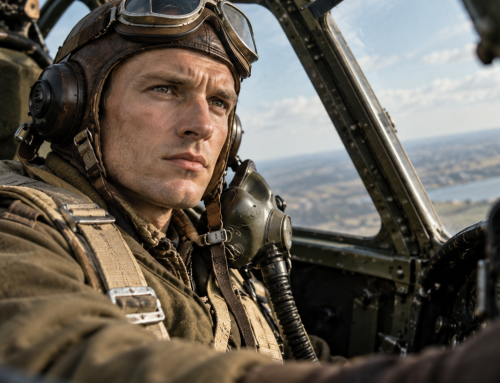
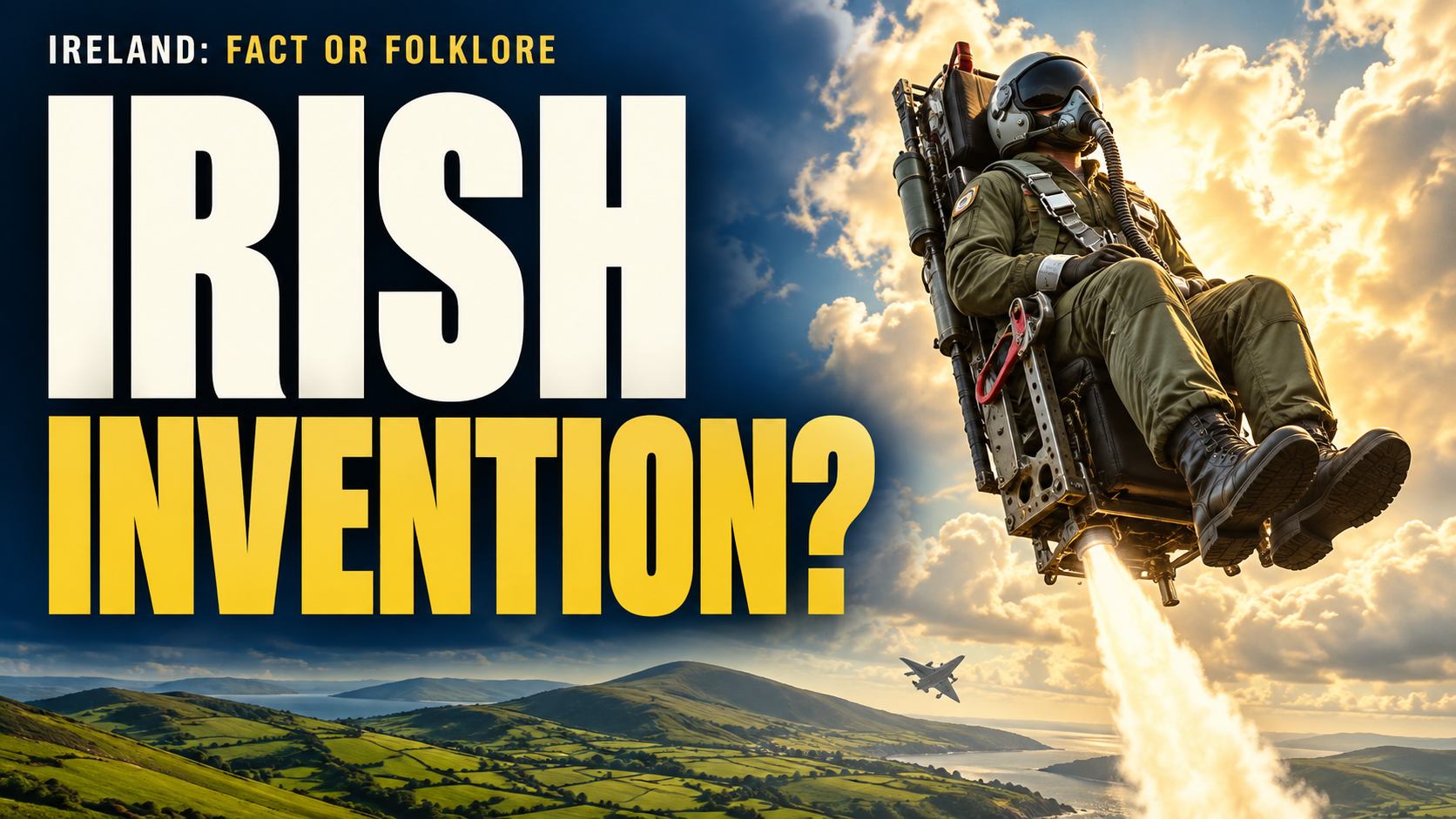
Discover the remarkable story of County Down engineer Sir James Martin, Martin-Baker and the ejection seat that has helped save more than 7,800 aircrew.
Imagine being inside a damaged jet aircraft.
The controls are no longer responding. The ground is getting closer. There is no runway within reach and no time to climb out of the cockpit.
There is one final option.
You pull a handle.
Within seconds, the canopy is gone, the seat is propelled clear of the aircraft and a sequence of events begins that may give you something you did not have a few moments earlier: a chance to live.
One of the names most closely associated with making that possible belongs to a man born in rural County Down.
Sir James Martin.
But did an Irishman actually invent the ejection seat?
As is so often the case with history, the answer is much more interesting than a simple yes or no.
From County Down to aircraft engineering
James Martin was born on 11 September 1893 at Killinchy Woods, near Crossgar in County Down.
His father, Thomas Martin, was both a farmer and an inventor, and James developed an interest in engineering while still young. Rather than following the conventional university route, he developed his engineering knowledge practically and eventually moved to England.
By 1929 he had established Martin’s Aircraft Works. In 1934, he formed the Martin-Baker Aircraft Company with Captain Valentine Baker, an experienced pilot whose flying knowledge complemented Martin’s engineering ability.
Their original ambition was not to manufacture ejection seats.
They wanted to build aircraft.
And then tragedy changed everything.
The death that changed James Martin’s work
On 12 September 1942, Valentine Baker was test-flying the Martin-Baker MB3 fighter.
Its engine seized.
Baker attempted an emergency landing, but the aircraft struck a tree stump and cartwheeled. He was killed.
For Martin, this was more than the loss of a test pilot. Baker was his friend and business partner.
Martin-Baker records that Baker’s death profoundly affected James Martin and that pilot safety subsequently became a central focus of his work.
It creates one of the most striking parts of the story.
Martin had spent years trying to build better aircraft.
Now he began concentrating on what happened when an aircraft could no longer be saved.
The problem with escaping a jet
In slower aircraft, a pilot might have been able to open the cockpit and bail out with a parachute.
As aircraft became faster, that became increasingly difficult and dangerous.
The pilot had to get clear of the aircraft itself, avoid the tail and other structures, survive the forces involved and then deploy a parachute.
By 1944, Britain’s Ministry of Aircraft Production asked James Martin to investigate a means of assisted escape for fighter pilots.
Martin concluded that one of the most practical answers was to eject the pilot while still sitting in the seat, using an explosive charge to propel the seat away from the aircraft.
It sounds straightforward when reduced to a sentence.
Making it work without severely injuring or killing the person sitting in the seat was another matter entirely.
Someone eventually had to test it.
Meet Bernard “Benny” Lynch
This is where another person enters the story who deserves to be remembered.
Bernard Lynch was a Martin-Baker employee who became the human test subject for the developing escape system.
On 24 January 1945, Lynch carried out a static ejection using a specially constructed test tower.
Then, on 24 July 1946, he did something considerably more alarming.
He climbed into the rear cockpit of a modified Gloster Meteor flying at approximately 320 mph (515 km/h), around 8,000 ft (2,440 m) above the ground.
And ejected.
He landed safely.
Martin-Baker says Lynch subsequently completed another sixteen test ejections.
There are easier ways of earning a day’s wages.
The first life saved
Testing was one thing.
The real question was what would happen when a pilot had no choice.
That answer came on 30 May 1949.
Test pilot John Oliver “Jo” Lancaster was flying an experimental Armstrong Whitworth AW.52 when the aircraft developed serious problems.
Lancaster was forced to use his Martin-Baker seat.
He ejected at around 5,000 ft (1,524 m) and survived, becoming the first person whose life was saved during a genuine emergency by a Martin-Baker ejection seat.
James Martin later presented Lancaster with a gold Rolex watch engraved with his name and the date of the ejection.
Lancaster was Ejectee Number One.
He would certainly not be the last.
More than 7,800 lives
The number attached to the Martin-Baker story is extraordinary.
As of 24 August 2026, Martin-Baker’s recorded total had reached 7,827 successful lives saved following another successful ejection involving a Hungarian JAS-39C Gripen.
Behind that number are thousands of individual stories.
Pilots who returned to their families.
Aircrew who survived accidents that might once have been fatal.
People who climbed into an aircraft never expecting that the seat beneath them would become their final escape route.
Martin-Baker says more than 16,500 of its seats were in service with 106 operators across 86 countries by June 2026.
And the company’s connection with Northern Ireland did not disappear.
James Martin later established an ejection-seat testing facility at Langford Lodge in County Antrim. Martin-Baker says the high-speed test track remains in use today.
So did James Martin invent the ejection seat?
Here comes the Fact or Folklore part.
Calling James Martin the inventor of the ejection seat is an appealing story.
It is also too simple.
Ideas for mechanically ejecting someone from an aircraft existed before Martin began his work.
The RAF Museum credits British engineer Everard Calthrop with an early concept and Romanian-born inventor Anastase Dragomir with designing and building the first working model in 1928. Dragomir’s patent described a “catapultable cockpit”.
Other nations were also developing escape systems during the Second World War. German and Swedish aircraft had experimented with or used forms of ejection seat before Martin-Baker’s system entered service.
So the folklore version — that James Martin simply woke up one morning in County Down and invented the world’s first ejection seat — does not survive examination.
But neither does that diminish his achievement.
The verdict: fact, with an important correction
James Martin was not the first person to conceive an ejection seat.
What he and the Martin-Baker team did was help transform the idea into a practical, continually developed escape system capable of saving aircrew under real-world conditions.
And perhaps that is the more impressive story.
The important invention is not always the first sketch on a piece of paper.
Sometimes it is the version that works when someone’s life depends upon it.
For James Martin, the story began with engineering ambition in County Down, passed through the devastating death of his friend Valentine Baker and eventually became a technology associated with thousands of people surviving what might otherwise have been their final flight.
More than a century after Martin’s birth, pilots around the world still sit on technology carrying the Martin-Baker name.
Not bad for a farmer’s son from County Down.
Watch the full story
There is much more to James Martin’s story, including the dangerous human testing behind the early seats, Jo Lancaster’s extraordinary escape and how the technology developed.
Watch Did an Irishman Invent the Ejection Seat? The James Martin Story on Ireland: Fact or Folklore on Youtube
And our next Irish invention takes us from the cockpit to the roadside.
A Belfast doctor looked at what happened when someone’s heart suddenly stopped and decided that the equipment needed to save them should no longer remain inside a hospital.
His name was Frank Pantridge.
That story is coming next on Ireland: Fact or Folklore.
Original Sources and Further Reading
Where possible, the story above has been checked against original patents, Martin-Baker’s own historical records and the RAF Museum.
1. Martin-Baker – The History and Development of the Mk1–Mk10 Ejection Seats
This is one of the most useful documents for the episode. It covers Valentine Baker’s fatal 1942 crash, James Martin being asked in 1944 to investigate assisted escape, the development of the explosive ejection system and the early testing programme.
Read the Martin-Baker historical document (PDF)
2. Martin-Baker – Company History
Martin-Baker’s official history records the establishment of the company, Valentine Baker’s death, Bernard Lynch’s test ejections, Jo Lancaster’s first emergency escape and the later Langford Lodge test facility in Northern Ireland.
Martin-Baker: Our History
3. Anastase Dragomir and Tănase Dobrescu – French Patent FR678566A
This is particularly important for the Fact or Folklore verdict. The original French patent has a priority date of 3 November 1928 and concerns a system in which a passenger and parachute could be separated from an aircraft. It demonstrates that escape-seat concepts existed before James Martin’s wartime work.
View the original FR678566A patent record and drawings
4. James Martin – Ejection Seat and Parachute Assembly Patent
James Martin’s US Patent 2,762,588, filed in 1955 with British priority from January 1954, describes an ejection-seat and parachute arrangement and includes the original technical drawings. This is an excellent primary source for readers interested in how Martin’s system developed.
View James Martin’s US2762588A patent and drawings
5. James Martin and Martin-Baker – UK Ejection Seat Patent GB831472A
This later British patent, filed with priority from 1957, shows continuing development of the Martin-Baker seat, including restraints intended to protect the pilot’s arms during ejection.
View British Patent GB831472A
6. RAF Museum – Bernard Lynch’s 1946 Ejection
The RAF Museum’s official aviation timeline records Bernard Lynch’s ejection from a Gloster Meteor on 24 July 1946 using a Martin-Baker seat.
RAF Museum: British Aviation in 1946
7. RAF Museum – Jo Lancaster’s Emergency Ejection, 30 May 1949
The RAF Museum records J. O. Lancaster’s successful emergency escape from the experimental Armstrong Whitworth AW52 on 30 May 1949.
RAF Museum: British Aviation in 1949
8. Martin-Baker – 75th Anniversary of Jo Lancaster’s Ejection
Martin-Baker’s anniversary record includes photographs and details of Lancaster’s 1949 emergency ejection and his later association with the company.
Martin-Baker: 75 Years Since the First Emergency Ejection
9. Dictionary of Irish Biography – Sir James Martin
For Martin’s Irish background, this is a strong scholarly reference. It records his birth at Killinchy Woods, Crossgar, County Down, on 11 September 1893 and traces his engineering career and work on aircrew safety.
Dictionary of Irish Biography: Sir James Martin
A note on the claim that James Martin “invented the ejection seat”
The surviving patent evidence shows that aircraft escape-seat concepts pre-dated Martin-Baker. For that reason, Ireland: Fact or Folklore podcast does not describe James Martin as the sole or original inventor of the concept.
His major contribution was the development, testing and continued refinement of the Martin-Baker ejection-seat system, which became a practical means of saving aircrew from stricken aircraft.