Cosy in Ireland • Companion to Ireland: Fact or Folklore Podcast
You can understand every word in an Irish conversation and still wonder what on earth just happened. Someone is “grand”, a stranger is “your man”, and the evening’s success apparently depends on the “craic”.
These expressions carry humour, familiarity and a sense of place. Their origins can also carry a fair amount of wishful thinking. A saying may be loved in Ireland without beginning there, while an ordinary English word may have Irish roots hiding in plain sight.
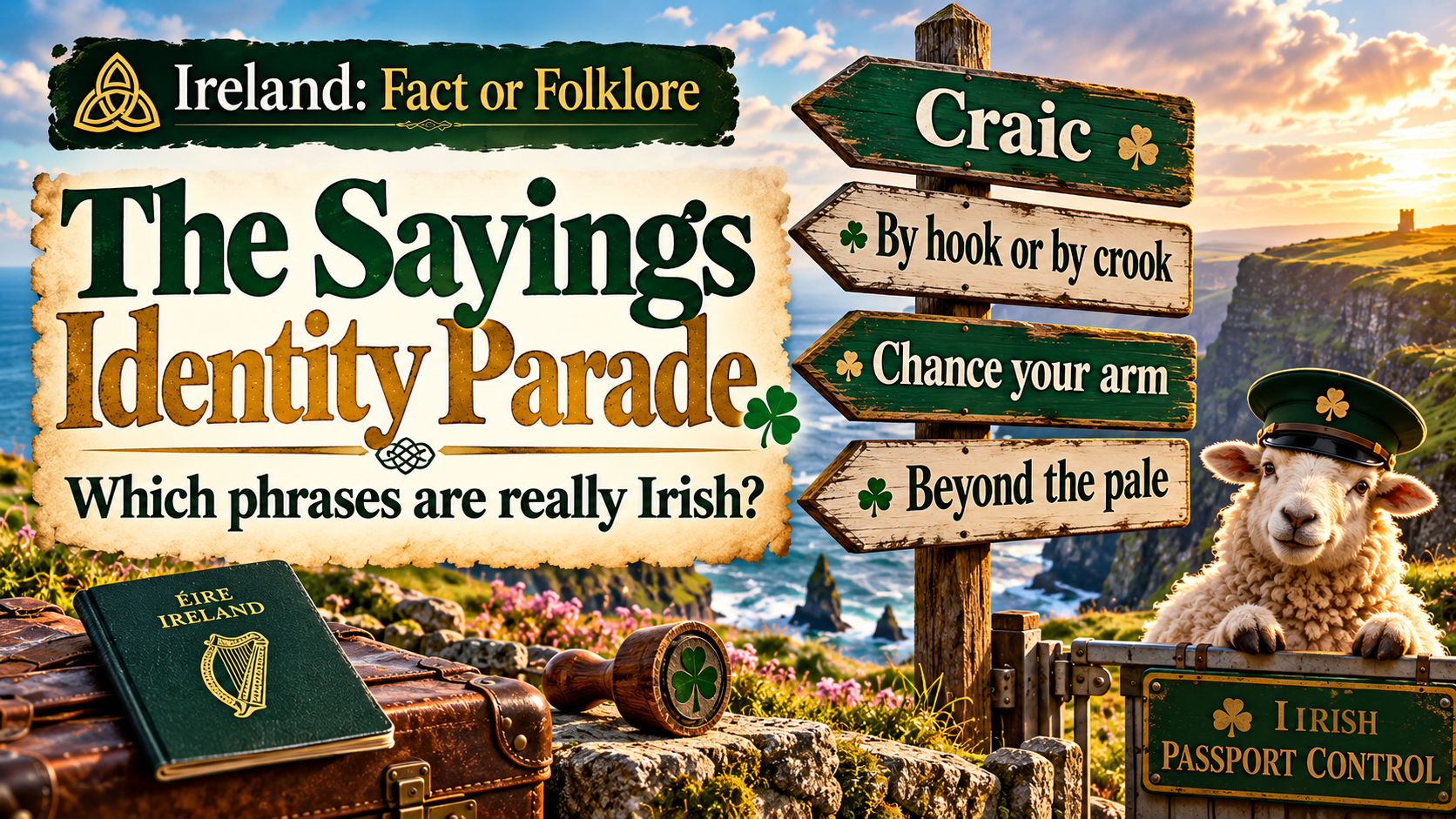
Here is a closer look at the sayings from our ten-minute episode, including one famous origin story that the dates simply will not allow. Four extra expressions below give website readers a little more to talk about.
What is the craic
“What’s the craic?” usually asks what is happening or whether there is any news. “The craic was great” describes an enjoyable time, lively conversation or good company. Pronounce craic like “crack”; no building inspection is required.
Its history crosses languages. Scots and northern English used crack for talk or conversation. The word entered Irish as craic, and that spelling was subsequently taken into English. The Ulster Scots Academy traces the relationship between these forms. [1]
That makes the claim of an ancient, unchanged Irish word misleading. It does not make today’s Irish usage somehow inauthentic. Borrowed words become part of everyday life, much as a visiting cat can become a permanent resident without anybody quite remembering the agreement.
By hook or by crook
This means finding a way to achieve something, by whatever means are available. “I’ll get there by hook or by crook” is a promise of determination, although it says very little about the reliability of your transport.
A familiar tale connects the expression with Oliver Cromwell and Waterford. Hook Head and Crooke provide wonderfully convenient place names, and Cromwell supposedly vowed to take the city by one route or the other.
The problem is timing. The expression is recorded in late fourteenth-century English, centuries before Cromwell’s seventeenth-century campaign. That campaign cannot have created it. [2, 3]
The wider origin remains debated. Gathering dead wood with hooked implements is one proposed explanation, discussed by etymologist Anatoly Liberman. It deserves consideration, but should not be presented as a certainty. The Waterford story is memorable; its Cromwell version fails the calendar test.
Chance your arm
To chance your arm is to take a risk in the hope of a useful result. It might mean asking for a discount or applying for a job you think is beyond your reach. Ideally, both arms remain safely attached throughout.
Saint Patrick’s Cathedral in Dublin preserves a much more dramatic tradition. During a feud in 1492 between the Butlers and the FitzGeralds, Gerald FitzGerald is said to have offered his arm through a hole in a door as a gesture of peace. The handshake that followed ended the confrontation in the cathedral’s account. [4]
It is an effective story about trust: somebody has to make the first vulnerable move. Its connection to the expression is less secure. Michael Quinion notes nineteenth-century evidence for the saying and argues that late Victorian British slang is the likeliest setting for its origin. [5]
The honest verdict is that the cathedral tradition and the origin of the idiom are separate questions. The story can be meaningful without being a proven linguistic birth certificate.
Beyond the pale
If behaviour is “beyond the pale”, it is unacceptable or outside recognised limits. Borrowing a book is one thing. Returning it with the final chapter missing is quite another.
The usual Irish explanation points to the medieval Pale, the territory under direct English Crown control. The place was real, but that does not establish the origin of the expression.
Pale could mean a stake or fence, and then a boundary. The Oxford English Dictionary’s caution, reproduced in the Wiktionary entry, is that the early historical evidence does not support deriving the phrase from a specific geographical Pale. [6]
So “the Irish connection is unproven” is the careful conclusion. It would be equally misleading to claim that every detail of a different origin has been settled. Sometimes the most useful discovery is knowing where certainty ends.
I am grand and your man
These are reminders that meaning lives in context. “I’m grand” can mean you are well or doing reasonably all right. In response to another helping of food, “No, I’m grand” can politely mean you have had enough. Tone supplies the rest of the message.
“Your man” can identify a man whom the listener is expected to recognise: your man from the shop, for example. He need not be your partner, relative or employee. Visitors can relax; nobody has assigned them responsibility for a stranger.
These are illustrations of Irish English usage, not claims that Ireland invented each individual word. Expressions vary across places, generations and speakers, so there is no single script that every Irish conversation follows.
Smithereens and galore
After all those questioned connections, here are two with stronger Irish credentials. To smash something to smithereens is to break it into tiny pieces. Merriam-Webster identifies Irish smidiríní, meaning little bits, as the likely source, while retaining uncertainty about the precise derivation. [7]
Galore has a clearer dictionary trail. Merriam-Webster derives it from Irish go leor, meaning enough or plenty. In English it usually follows its noun: stories galore, bargains galore, biscuits galore. [8]
An Irish contribution can be sitting in an entirely ordinary sentence, quietly getting on with the job. It does not need a leprechaun beside it to prove its credentials.
The gift of the gab
To have “the gift of the gab” is to speak fluently and persuasively. Think of the person who turns a request for directions into a conversation, a recommendation and an invitation to somebody’s wedding.
The phrase is closely associated with the Blarney Stone and its promise of persuasive speech. That is a cultural connection, however, rather than proof that the expression itself began at the castle.
Etymonline records “gift of the gab” from the 1680s and discusses the wider history of gab, including Scottish and northern English associations with the mouth. [9] The evidence does not justify presenting the whole phrase as an exclusively Irish invention. Ireland has certainly made it feel welcome.
Away with the fairies
“Away with the fairies” describes someone who seems detached from what is going on, absorbed in their own world or unrealistic about a situation. Collins records it as an informal expression meaning out of touch with reality. [10]
Imagine asking whether the bins have gone out and receiving a detailed answer about the holiday cottage your companion has been picturing. Their body is in the kitchen; the rest of them has already checked in.
The fairy imagery makes it a natural fit for an Irish folklore discussion, but imagery alone cannot establish a specifically Irish origin. The dictionary confirms the meaning, not a birthplace. It can also sound dismissive, so the gentlest joke is usually the one you make about yourself.
Donkeys years
“I haven’t seen you in donkey’s years” means it has been a very long time. Nobody expects a calculation based on the birthday of an actual donkey.
The surprising possibility is that the joke began with ears. Grammarphobia discusses early twentieth-century examples of both “donkey’s ears” and “donkey’s years”, explaining the likely wordplay on the animal’s long ears. It also notes that the order in which the two forms developed is uncertain. [11]
This is a wider British English expression, not one the cited evidence identifies as an Irish invention. Hearing it from an Irish grandparent tells us where it lived in your family, rather than where it first entered the language. Either way, it is a much friendlier greeting than “You appear to have aged considerably.”
Raining cats and dogs
This means rain is falling very heavily: the sort of weather that makes “I’ll just nip out” sound wildly optimistic.
There is an Irish literary connection. Jonathan Swift used the familiar wording in his 1738 collection of polite conversation. But Richard Brome’s comedy The City Wit contained a related expression involving dogs and polecats in 1653. Swift’s use does not prove that he invented it. [12]
The precise origin remains uncertain. The often-repeated story about pets sheltering in thatched roofs and sliding out in the rain has no credible support as an explanation. Phrase Finder examines and rejects that account. [12]
So this one belongs in our collection of sayings used far beyond Ireland, with a Swift connection rather than a proven Irish birth certificate. You may need an umbrella, but there is no reason to bring a pet carrier.
The stories we carry
Language travels with people. Words are borrowed, reshaped and made familiar through years of use. Finding that a favourite expression has crossed a border gives us another part of its story.
A good origin check asks whether the dates fit, whether early examples survive, and whether a source is preserving a tradition or demonstrating a linguistic connection. The earliest written example is evidence of use, not necessarily the moment somebody first said it.
Which expression did your family use that confused everyone else? Share the saying, what it meant and where you heard it. A kitchen-table phrase could be the starting point for our next investigation.
Listen to the accompanying Ireland: Fact or Folklore episode for the original sayings identity parade, and explore more Irish stories here on Cosy in Ireland.
References and further reading
The numbered references support the origin discussions above. Descriptions distinguish historical traditions from evidence about the expressions themselves. Sources checked 24 September 2026.
1 Ulster Scots Academy
From Ulster to America entry for crack. Explains the relationship with Irish craic.
2 Oxford University Press
Anatoly Liberman, By hook or by crook, 25 May 2016. Examines medieval evidence and competing explanations.
3 World Wide Words
Michael Quinion, By hook or by crook. Discusses the Cromwell story and the earlier written record.
4 Saint Patricks Cathedral
Life and History. The cathedral’s account of the 1492 feud and reconciliation tradition.
5 World Wide Words
Michael Quinion, Chance your arm. Reviews the late nineteenth-century evidence and questions the cathedral origin claim.
6 Wiktionary
Beyond the pale, etymology section. Reproduces the Oxford English Dictionary’s caution about specific geographical derivations; this is an indirect citation of the OED.
7 Merriam Webster
Smithereens. Definition and qualified discussion of its likely Irish source.
8 Merriam Webster
Galore. Definition and derivation from Irish go leor.
9 Online Etymology Dictionary
Gab. Dates the expression and discusses the word’s wider linguistic background.
10 Collins English Dictionary
Away with the fairies. Supports the modern meaning; does not establish an Irish origin.
11 Grammarphobia
Patricia T O’Conner and Stewart Kellerman, Donkey’s years, 5 December 2012. Discusses early examples and the ears and years wordplay.
12 Phrase Finder
Gary Martin, Raining cats and dogs. Reviews the Brome and Swift examples and rejects the thatched-roof explanation.