THE EVIDENCE ROOM
If Saint Brendan Landed in America,
What Would Be Left?
An archaeological case file that begins where the podcast ends
COSY IN IRELAND • COMPANION TO IRELAND: FACT OR FOLKLORE
“A voyage can be possible, memorable and still leave no case that archaeology can prove.”
The discovery that never happened
Imagine a windswept excavation on the coast of Newfoundland. An archaeologist draws a trowel across a dark layer of soil and touches metal. The object is lifted, photographed and recorded. It is a small handbell of unmistakably early Irish workmanship. Beside it are a hearth, worked timber and fragments of a hide-covered boat. Charcoal from the fire dates to the sixth century.
By lunchtime, Saint Brendan’s voyage has changed from an extraordinary possibility into one of the greatest archaeological discoveries of the century.
There is one problem: this scene is imaginary.
No accepted Irish monastic site of Brendan’s period has been found in North America. No securely excavated bell, book fitting, inscription or boat fragment places an Irish crew there before the Norse. That absence is why the podcast verdict remains possible, but not proven.
Yet the missing evidence is more interesting than a simple ‘no’. It allows us to ask a better question: if Brendan or another early Irish crew really landed, what traces might they have left?
Case rule: an object needs an address
A curious object is not automatically evidence. Archaeology depends on context: the exact place an item was found, the layer surrounding it, its relationship to nearby features and whether that layer has been disturbed.
A cross scratched on a loose stone may be old, recent, natural or wrongly interpreted. A metal object bought from a collector may be genuine but historically almost useless if nobody knows where it came from. The strongest discovery would unite several independent clues in one sealed context.
THE TEST: object + undisturbed layer + reliable date + cultural identification. One exciting resemblance is not enough.
Clue one: the landing place
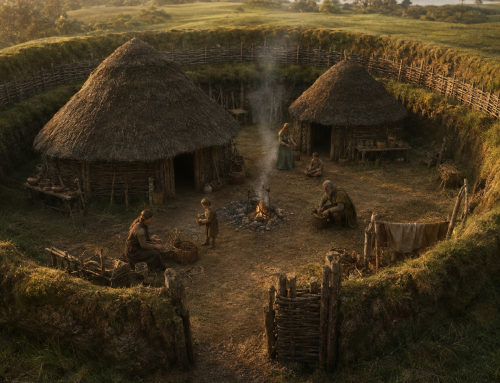
A small crew would first need shelter, fresh water and a place to repair the vessel. Even a brief stop might produce a hearth, charcoal, burnt bone, food remains, cut branches, stake holes or a working surface where tools were used.
A longer stay could leave post holes, drainage, rubbish deposits or repeated fires. None would look dramatic at first. Archaeologists often find human presence through changes in soil colour and texture rather than treasure.
The coast complicates matters. Erosion can remove whole occupation surfaces. Sand can bury them. Rising or falling shorelines can place an old landing site far from the modern water. A crew may also have chosen a sheltered cove that has never been excavated. Missing evidence is therefore not proof that nobody arrived; it is a limit on what we can responsibly claim.
Clue two: the boat that wanted to disappear
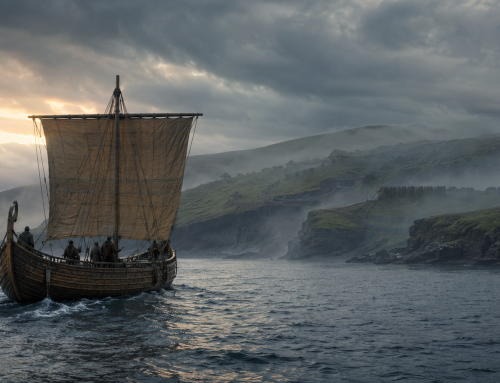
A currach was a clever but archaeologically frustrating vessel. Timber, hide, fibre cord and grease are organic materials. In ordinary damp, oxygen-rich soil they decay. A boat abandoned above the tideline might vanish almost completely, especially after centuries of weather and scavenging.
Preservation would require unusual conditions: waterlogging without oxygen, deep burial, freezing, charring or mineral replacement. Even then, identifying a fragment as Irish rather than simply part of an unknown small craft would demand construction details and a trustworthy date.
Tim Severin’s twentieth-century crossing showed that a hide-covered vessel could survive the northern route. It did not show that one survived in the ground. Feasibility and preservation are two different problems — and Brendan’s case must overcome both.
Clue three: what was in a monk’s pocket?
The most persuasive object might be something small and accidentally lost. A simple dress pin, whetstone or knife could survive, but these everyday objects travelled widely and might not identify an Irish crew. The better candidates are objects with a distinctive cultural and chronological signature.
A handbell, book fitting, inscribed piece of metalwork or recognisably Insular ecclesiastical object could be important. But even a beautiful Irish-looking artefact would need to come from a controlled excavation. Trade, later visitors and modern collecting can move objects far from their original owners.
The dream discovery is not a solitary treasure. It is a group: an Irish ecclesiastical object, a dated hearth and the remains of a working camp, all belonging to the same early layer. That is the sort of pattern that could withstand scrutiny.
Clue four: nature is not a map
The Voyage of Saint Brendan contains details that invite geographical guessing. A crystal pillar resembles an iceberg. A crowded island recalls North Atlantic seabird cliffs. Burning material suggests a volcanic landscape. Whales, dolphins, gannets, puffins and storm petrels all belong to the wider ocean world a crew might have encountered.
These details may preserve genuine seafaring knowledge. They may also be symbols, borrowed reports or imaginative transformations. An iceberg does not carry a place-name. Birds range far from land. Volcanoes do not point exclusively to Iceland. Natural resemblance can make a route feel plausible without fixing it on a chart.
This is where folklore does something history cannot: it preserves the sensation of the ocean — terror, abundance, uncertainty and wonder — even when it loses the coordinates.
The evidence Brendan needs already exists — for the Norse
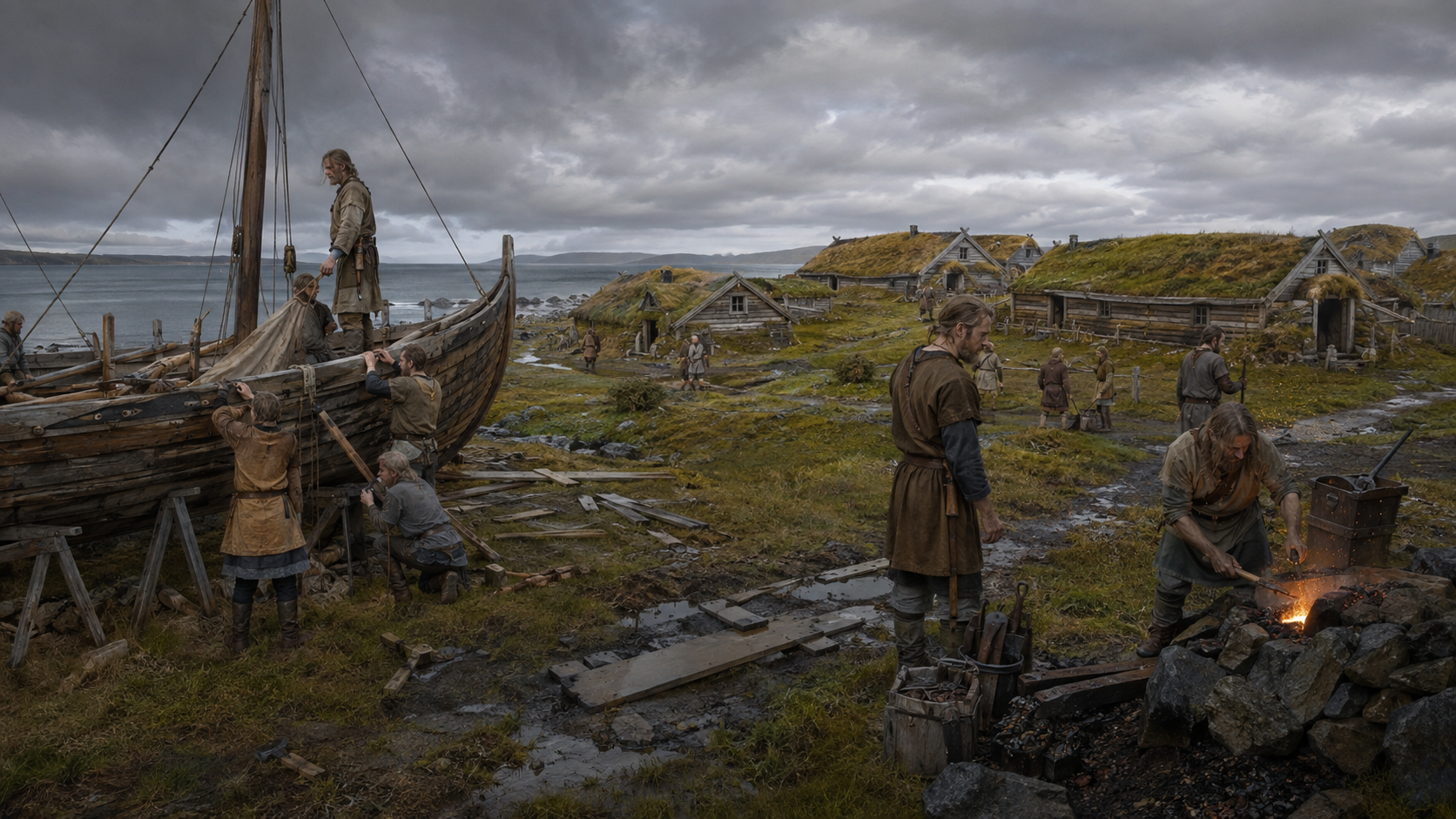
At L’Anse aux Meadows, archaeologists found the remains of eight timber-framed sod buildings in three complexes, together with evidence of ironworking, woodworking and ship repair. The site is the only authenticated Norse archaeological site in the Americas and the earliest securely known European presence on the continent.
Then three pieces of wood made the comparison even sharper. A cosmic-ray event in AD 993 left a radiocarbon signal in tree rings. Researchers identified that marker in wood cut with metal tools and counted outwards to the bark. All three trees had been felled in 1021.
That is what a successful archaeological case looks like: structures, activities, objects, excavation context and a date that independent scientific analysis can test. Brendan has a powerful story and a workable boat. The Norse have a site.
The land was never waiting to be discovered
The search for the ‘first European’ must not erase the people already living in North America. Indigenous communities had occupied and understood these landscapes for thousands of years. Parks Canada notes several millennia of human presence in the region of L’Anse aux Meadows, of which the Norse camp was one short episode.
A Brendan discovery would change the history of European Atlantic travel. It would not turn an inhabited continent into an empty prize, and it would not make an Irish monk its discoverer.
The Evidence Room verdict
CURRENT VERDICT: A pre-Norse Irish crossing was physically possible, but no accepted archaeological evidence currently proves that Saint Brendan or another Irish monastic crew reached North America.
That answer is less final than it sounds. Archaeology changes when something new emerges from the ground, a forgotten collection is re-examined, or scientific dating becomes more precise. The responsible position is not to mock the legend or promote it as fact. It is to keep the case open without pretending the missing evidence has already been found.
Perhaps the most fitting ending is that Brendan remains just beyond the visible horizon: close enough to imagine, far enough to question.
Your turn in the Evidence Room
- Which single discovery would persuade you most?
- A sixth-century Irish handbell in a sealed Newfoundland layer
- A hide-boat repair site with a secure radiocarbon date
- An early inscription confirmed independently by several specialists
Leave your verdict with the episode or on the Cosy in Ireland companion page. In future Evidence Room articles, we will take one seductive claim from Irish history or folklore and ask not only whether it sounds true, but what proof would have to look like. The mystery changes each time; the standard of evidence does not.
Listen to the companion episode
Did an Irish Monk Reach America Before the Vikings?
Sources and further reading
- Kuitems, Margot et al., ‘Evidence for European presence in the Americas in AD 1021’, Nature 601 (2022), 388–391. https://doi.org/10.1038/s41586-021-03972-8
- Parks Canada, ‘L’Anse aux Meadows National Historic Site’ and ‘Culture and history’. https://parks.canada.ca/lhn-nhs/nl/meadows
- Newfoundland and Labrador Heritage, ‘Irish Monks and the Voyage of St Brendan’. https://www.heritage.nf.ca/articles/exploration/st-brendan-voyage.php
- University College Cork, CELT bibliography and resources relating to the Navigatio Sancti Brendani Abbatis. https://celt.ucc.ie/
- Severin, Tim, The Brendan Voyage (Hutchinson, 1978). Demonstrates feasibility, not the historical voyage.
- Burgess, Glyn S. and Clara Strijbosch, The Legend of St Brendan: A Critical Bibliography (Royal Irish Academy, 2000).
Editorial and originality note
This article was newly written for Cosy in Ireland as an archaeological evidence case file. It complements the podcast without reproducing its structure or wording. Hypothetical discoveries are clearly identified, and no claim is presented as established without supporting evidence.