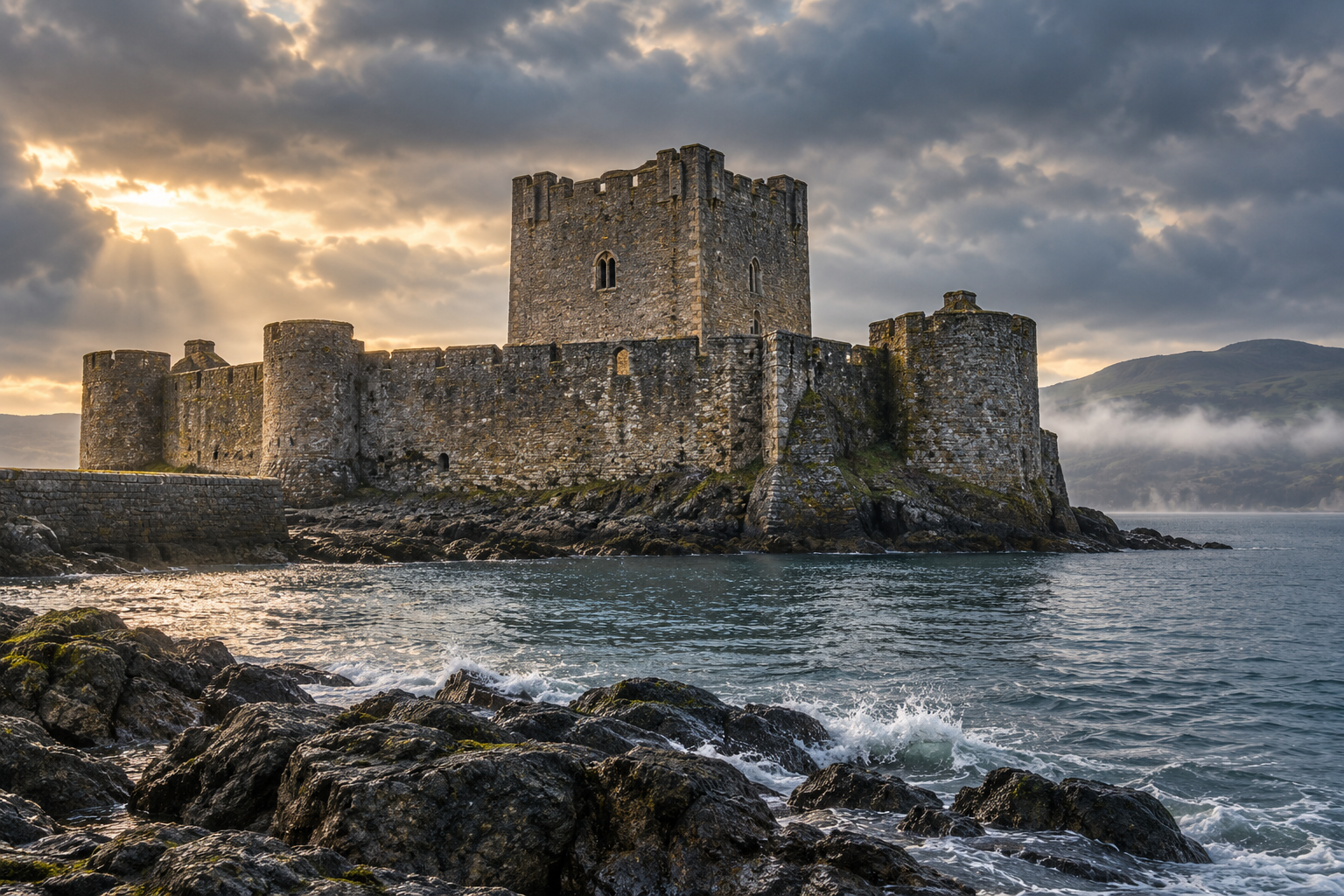
Carrickfergus Castle looks unconquerable. Its record says otherwise. The fortress was besieged and captured repeatedly, yet remained a working military site for roughly seven and a half centuries. Its real achievement was not invincibility but continued relevance.
The short answer
The claim that Carrickfergus Castle was impregnable is fantasy. King John asserted control over it in 1210; Edward Bruce’s forces captured it after a prolonged siege in 1316; Schomberg’s Williamite army took it in 1689; and a French expedition forced its surrender in 1760.
The castle was nevertheless exceptionally strong and strategically important. Its coastal position, layered defences and capacity for adaptation made it valuable long after the medieval world that created it had disappeared.
Why build a castle here?
Carrickfergus stands on the northern shore of Belfast Lough in County Antrim. Before modern land reclamation altered the shoreline, the rock projected farther into the water and the sea protected much more of the castle’s perimeter. Ships could approach with people and supplies, while the garrison could watch movement through the lough and along the coast.
Belfast now dominates the area, but medieval Carrickfergus was the more important settlement. Castle, port and town developed together. Holding the rock meant controlling a useful landing place and a route into eastern Ulster.
The Rock of Fergus: history or legend?
Carrickfergus derives from the Irish Carraig Fhearghais, meaning the Rock of Fergus. Tradition links the name with Fergus Mór, a ruler associated with Dál Riata, the early medieval kingdom that connected north-east Ireland and western Scotland. One version says that Fergus drowned or was shipwrecked at the rock.
The place-name is genuine, but the story is not a documented biography. Different traditions identify Fergus differently, and later writers sometimes confused several legendary figures bearing the name. The safest conclusion is that a Fergus tradition became attached to the rock; the surviving evidence cannot establish exactly who he was or whether the shipwreck occurred.
John de Courcy and the first castle
The Anglo-Norman knight John de Courcy founded the castle in the late twelfth century after pushing into eastern Ulster in 1177. That year is conventionally used as the castle’s foundation date, although construction developed over time rather than beginning and ending as one project.
De Courcy needed more than a defensive refuge. He required a headquarters from which to govern a new lordship. The great tower, curtain wall and inner ward combined military protection with accommodation, storage and political display. Building in stone announced that the new regime intended to remain.
Hugh de Lacy later displaced de Courcy and continued the castle’s development. King John came to Ireland in 1210, besieged Carrickfergus and brought the stronghold under royal authority. During the thirteenth century its gatehouse, towers, walls and wards created several defensive layers along the rock.
Life behind the walls
Carrickfergus was not inhabited only by lords and knights. A working castle required soldiers, cooks, servants, craftspeople, clerks and clergy. The surrounding town supplied grain, meat, fish, ale, fuel, cloth and labour.
Daily life was less comfortable than restored halls can suggest. Thick masonry, restricted windows, open fires, damp air and crowded rooms produced cold, smoke and strong smells. Water had to be carried, food prepared, animals managed and equipment repaired. The castle was a workplace as well as a residence and fortress.
Archaeology restores some of these ordinary lives to the story. Excavations in the inner ward have found surviving deposits despite centuries of construction and demolition. Pottery, animal bone, building remains and later military features help researchers reconstruct diet, trade and changing use.
Edward Bruce: a fortress defeated by hunger
Edward Bruce, brother of Robert the Bruce, landed in Ulster in 1315 during an attempt to remove English authority and become king of Ireland. His forces controlled the town while the castle garrison continued to resist. The siege lasted into 1316, when the fortress eventually fell.
Later accounts emphasise the defenders’ desperate hunger. Dramatic details about exactly what they ate should be traced to their sources before being repeated as fact. The central point is secure: strong walls could delay an army but could not create food. Isolation and starvation could achieve what direct assault could not.
Bruce’s control was temporary. He was killed at Faughart in County Louth in 1318, ending his campaign for the Irish kingship.
Adapting to gunpowder
Medieval walls designed against arrows, crossbows and siege engines faced new risks as cannon became more effective. Carrickfergus was altered to accommodate artillery. Gun openings, firing positions and other defences changed as attack and defence developed.
This continual alteration explains part of the castle’s survival. Carrickfergus did not remain useful by staying unchanged. It remained useful because each generation adjusted it to new military and administrative needs.
Schomberg and William III
In 1689, during the Williamite war, forces commanded by Frederick Schomberg besieged and captured Carrickfergus from its Jacobite garrison. William III landed at Carrickfergus the following year before the campaign that led to the Battle of the Boyne.
The sequence matters. William did not personally capture Carrickfergus Castle. Schomberg’s forces took it in 1689; William arrived in 1690. Popular accounts sometimes compress the two events and give the better-known figure credit for both.
When the French captured Carrickfergus
In February 1760, during the Seven Years’ War, a French expedition led by François Thurot landed near Carrickfergus. Fighting moved through the town before the outnumbered garrison, short of ammunition, withdrew into the castle and surrendered.
The French held Carrickfergus for several days, obtained supplies and sailed away. Royal Navy ships intercepted Thurot’s force near the Isle of Man, where he was killed. The capture is documented history, not local folklore. It demonstrates again that walls could not compensate for inadequate manpower, ammunition and support.
An American connection
Carrickfergus also appeared at the edge of the American War of Independence. In April 1778, the American naval commander John Paul Jones brought Ranger into local waters and fought the Royal Navy sloop Drake outside Belfast Lough. Ranger captured Drake after a hard engagement.
Jones did not capture Carrickfergus Castle, and the battle did not take place within it. The incident is significant because it connects the shoreline to a wider Atlantic conflict and the formation of the United States.
From armoury to monument
The castle continued in use as a prison, armoury, magazine and garrison. Nineteenth-century alterations supported the storage and movement of munitions. Archaeological investigation has identified tracks and a turntable associated with an ordnance tunnel.
Military use ended in 1928, when the castle entered State Care. Some later additions were removed or altered to emphasise its Norman appearance. Conservation protected the monument, but restoration also influenced which phase of its long history visitors see most clearly.
Even then, its defensive story was not finished. During the Second World War, the castle housed air-raid shelters. A building begun in the age of crossbows was still serving a defensive purpose in the age of bombers.
Why Carrickfergus survived
- Its coastal rock remained strategically useful for centuries.
- Successive occupants repaired and adapted the buildings rather than abandoning them.
- Continuous military use reduced the opportunity for large-scale stone robbing and decay.
- Its transfer into State Care in 1928 established preservation and public access as its new functions.
- Its place in local and wider history kept the site culturally important.
Today the castle is managed by the Historic Environment Division of the Department for Communities and is considered one of the most complete surviving Norman castles in Ireland or Britain.
Final verdict
Fantasy: Carrickfergus Castle was never truly impregnable. Its documented captures make that claim impossible to sustain.
Fact: it was an unusually durable and adaptable fortress. Its defences forced enemies to commit time and resources, while its location kept it relevant through medieval, early modern and modern warfare.
Carrickfergus survived not because nobody defeated it, but because after every defeat somebody still considered the rock worth holding.
Pronunciation guide
Carraig Fhearghais: KARR-ig AR-ish; the initial “Fh” is silent.
Carrickfergus: KARR-ik-FER-gus.
Fergus Mór: FER-gus MORE.
Dál Riata: dawl REE-uh-duh.
John de Courcy: John duh KUR-see.
Hugh de Lacy: Hugh duh LAY-see.
Faughart: FAW-hart.
Schomberg: SHOM-berg.
François Thurot: frahn-SWA too-ROH.
Points to treat carefully
- The Fergus shipwreck is a place-name tradition, not verified history.
- The castle was founded in the late twelfth century; 1177 is the conventional date, but construction occurred in stages.
- Edward Bruce’s siege began in 1315 and the castle fell in 1316. Avoid compressing the town and castle captures into one event.
- Schomberg captured the castle in 1689. William III landed at Carrickfergus in 1690.
- John Paul Jones fought Drake outside Belfast Lough; he did not capture the castle.
Sources and further reading
Department for Communities: Carrickfergus Castle.
Department for Communities: Works to the Great Tower Roof.
Henry Welsh, “An Excavation at the Inner Ward, Carrickfergus Castle, County Antrim”, Ulster Journal of Archaeology 72 (2013–14). Academic excavation report.
Queen’s University Belfast: Carrickfergus Castle excavation report (2014). ht
History Ireland: Mapping and measuring the impact of the Bruce invasion.
Sean Duffy, Robert the Bruce’s Irish Wars (2002). Book-length account of the Bruce campaign.
Editorial note
This companion article is original and does not reproduce the podcast script word for word. Historical information has been paraphrased from the sources listed above. Visitor opening times, charges and access arrangements are not included because they can change and should be checked directly before travel.